Amazon’s fastest delivery promise now runs at less than half an hour in parts of London, and will be extended to Manchester and Birmingham this year. The speed is the point. It is also the cost.
Speed becomes the product and the constraint at the same time
The company is widening the offer at the same time it accelerates it. It will extend same-day delivery to Ipswich and Coventry while letting London customers fold fresh groceries into the same basket as electronics or clothing, a system where fruit, meat, dairy and frozen foods sit alongside fashion and DIY kits. What used to be separate supply chains now move as one. That only works if the infrastructure holds under strain.
The price signal suggests where the strain sits. For Prime members, same-day grocery delivery is an additional free option above £20; for everyone else, the fee is £5.99 regardless of basket size. The marginal cost of speed is being absorbed inside a subscription model that was not built around perishable goods. The faster the delivery, the less room there is to hide that cost anywhere else.
Infrastructure is being pushed to behave like a continuous system
Amazon is trying to outbuild the constraint. It is increasing use of robotics in its warehouses, deploying machines guided by AI voice controls to compress handling time, while in Darlington drone flights are being trialled as the first UK test of Prime Air. These are not retail upgrades. They are attempts to turn logistics into something closer to a continuous system, where goods do not wait. The system works if volume fills it. Grocery is the volume.
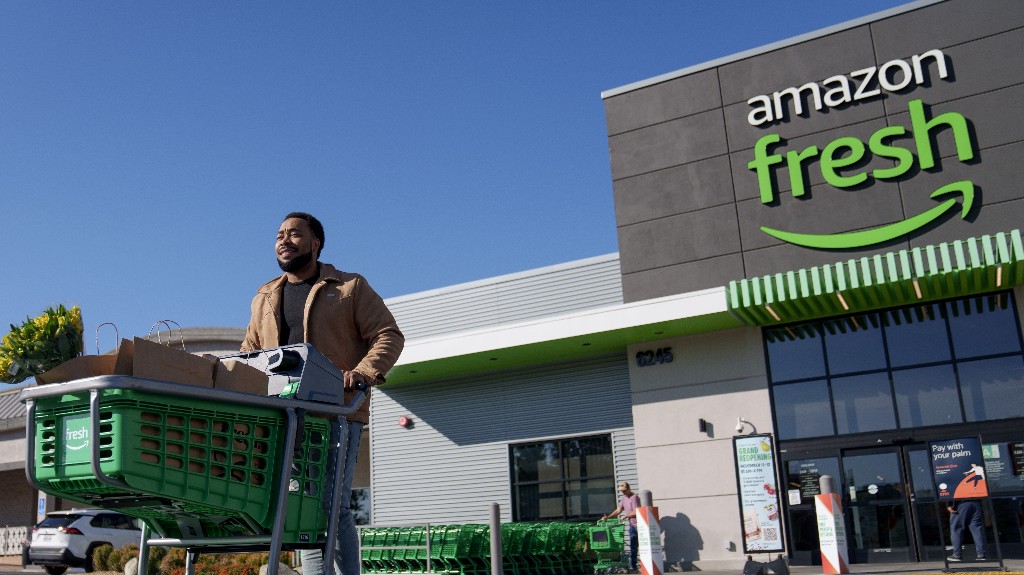
That is why the company is rewiring its approach after retreating from physical retail. It is overhauling its grocery strategy with a stronger focus on Whole Foods after shutting its “just walk out” stores, a format that could not scale. The problem was not technology; it was density. A grocery business cannot be a demonstration. It has to be everywhere, or it is nowhere.
Incumbent density defines a market that resists platform logic
The market it is trying to enter already decided what “everywhere” looks like. Tesco holds roughly 27.3% share, with Sainsbury’s, Asda and Morrisons layered beneath it, while Aldi and Lidl have pushed the discounter share to over 18% by 2026. The total market is worth about £230–240bn annually. It is large enough to attract Amazon’s capital and crowded enough to blunt it.
Despite its scale, Amazon has found it tough to compete with incumbents built around proximity and margin discipline. In that context, the company’s expansion looks less like an assault on grocery margins than an attempt to pull grocery into a different economic model entirely. Amazon did not become dominant by selling goods; it built infrastructure that others plug into. It is a marketplace, not a shop. Grocery is being forced through that logic.
Partnerships and capital reveal a model underwriting its own limits
The partnerships tell the same story. Amazon plans to double the number of Prime members with access to at least three grocery options through Morrisons, Iceland, Co-op and Gopuff. It is not replacing the supermarket; it is trying to sit on top of it. The supermarkets provide inventory and local reach. Amazon provides demand, logistics and the subscription layer that decides how fast the system runs.
The capital behind that shift is not incremental. The company booked £30bn in UK sales and says it will invest £40bn over three years from 2025, having already put more than £15bn into the UK in 2025. It employs around 75,000 workers in Britain. The scale is visible. The economics are not.
Because the faster Amazon moves groceries, the more it exposes what grocery margins cannot carry. Fresh food spoils. Delivery windows tighten. Returns are worthless. A system designed to distribute durable goods at speed is now handling inventory that decays by the hour. The infrastructure can be expanded. The underlying economics do not change with it.
This is where the apparent strength starts to look borrowed. Amazon’s model assumes that logistics efficiency can compress cost faster than the complexity of grocery expands it. Yet the company remains a minnow in UK grocery, even as it pours capital into a segment where incumbents already operate on thin margins and local density. The faster it scales, the more it inherits those margins without inheriting the pricing power that protects them.
The pressure does not sit in the technology or the customer proposition. It sits in the balance between speed and cost that the subscription model is quietly absorbing. Every free same-day delivery, every 30-minute promise, moves more of grocery’s structural constraints into a system that was built to bypass them. The infrastructure holds—for now.
What has not been priced in is that Amazon’s UK grocery push depends on turning a low-margin, high-friction market into a volume engine for a logistics platform that cannot slow down, and the £40bn it plans to spend is not buying share so much as underwriting the gap between how fast the system runs and what grocery can actually pay for.