
The proposed arrangement covers rare earths and other strategic minerals, and Ruto said the agreement was already in the works and could be concluded soon. Its timing is not accidental. G7 leaders agreed to step up coordination to cut their countries' reliance on China for critical minerals, including plans to align stockpiling and create a new platform with an expanded role for the International Energy Agency. The West wants new supply chains. Kenya wants a different place inside them.
Control over minerals is becoming a contest over where value is created
That demand is spreading across the continent. Countries across Africa have pushed in recent years to process more of the minerals they produce domestically, marking a shift towards keeping more value at home. Ruto pointed to the Democratic Republic of Congo, saying "It's the same thing that they are doing in DRC ... to make sure that whatever agreements, whatever deals are being fashioned are deals that benefit the country." He reduced the principle to a blunt rule: "They have to be processed in-country and in-continent."
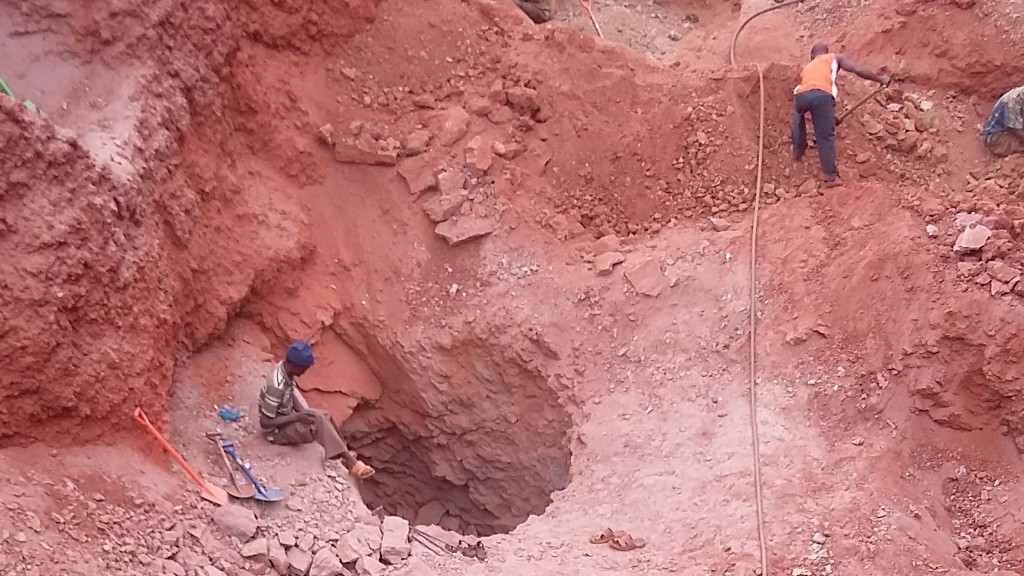
Kenya has reasons to insist. The country has large untapped deposits of niobium, lithium, graphite, copper and nickel. It also sits on gold, titanium, rare earth elements, gemstones, iron ore, manganese and chromite deposits. At Mrima Hill, where geology has become geopolitics, the government has issued a formal tender inviting global investors to develop deposits of niobium and rare earth elements valued by the state at roughly $62 billion. Preliminary estimates point to around 40 million tonnes of ore with roughly 5 per cent rare earth oxide content and nearly 680 million kilograms of niobium. Yet those valuations are based on early estimates and do not reflect measured, proven resources or mineable reserves. The promise is enormous. So is the gap between geological potential and industrial reality.
That gap already shows up in Kenya's mining numbers. The mining and quarrying sector recovered from a 7.8 per cent contraction in 2024 to grow 14.9 per cent in 2025, making it one of the economy's fastest-growing sectors. But the growth was driven largely by low-value industrial minerals rather than high-value exports. An 18 per cent jump in cement output to 10.4 million tonnes lifted demand for construction materials as the construction sector expanded by 6.8 per cent. Even so, the overall market value of minerals declined as global prices weakened.
The concentration is striking. Titanium continued to dominate export earnings, with titanium ores and concentrates accounting for the largest share of the total value of mineral output. Then prices collapsed. Titanium ore earnings fell to Sh7.8 billion in 2025, down 53.9 per cent from Sh17.0 billion in 2024 and far below the Sh28.3 billion peak recorded in 2022. Kenya produced more and earned less. That is precisely the vulnerability Ruto says Africa can no longer afford.
Geopolitics alone cannot make domestic processing economically durable
His argument extends beyond mining policy. Ruto said he agreed with Trump that partnerships should be based on investment rather than aid, because the continent no longer wanted relationships built on dependency or resource extraction. He sharpened the point further: "We are going to reject any relationships that are based on extraction of our natural resources," calling instead for job creation, industrial development and shared returns. At the same time, Kenya and other African nations would not choose between Washington and Beijing. "There are opportunities for everybody," he said, noting that Africa had recently concluded trade deals with China and hoped for deeper engagement with the United States and Europe.
The obstacle, in Ruto's telling, is not money. He told G7 leaders that Africa's main constraint was not a lack of capital but barriers to accessing it. "We are not short of capital ... what we need is a framework to mobilise it," he said, pointing to trillions of dollars in African pension funds, insurance assets and reserves. He called for guarantees and risk-sharing mechanisms from G7 countries to unlock that capital and lower borrowing costs.
The irony is that the countries most eager to diversify mineral supply chains are discovering how expensive diversification can be. Capital costs for projects in diversified regions are typically around 50 per cent higher than for incumbent producers. Those higher costs, combined with price volatility and economic uncertainty, are making it difficult to build diversified supply. Public financing support can help bring forward new projects, but rule-based market mechanisms are also required to support their operation. The West wants alternatives to concentrated supply chains. Kenya wants alternatives to extraction. Both ambitions depend on proving that processing minerals where they are mined is not simply politically attractive, but commercially durable. Until that happens, the most valuable asset in Kenya's minerals sector may not be the ore beneath the ground. It is the bargaining power created by refusing to sell it on yesterday's terms.
Cover photo Dianatieno CC BY-SA 4.0