
The immediate explanation sits below the operating line. Provisions and contingencies fell 43.7 per cent to ₹22.23bn, lifting profit before tax by 24.8 per cent to ₹94.37bn.[2] The comparison was unusually forgiving: the year-earlier quarter carried a one-off charge on part of the loan book following what Axis described as an “industry benchmarking” exercise involving credit overdraft facilities.[1] Lower credit costs therefore did more than improve the quarter. They changed the base against which the improvement was measured.
That does not make the result hollow. Net interest income rose 8 per cent to ₹146.46bn, supported by a 19 per cent expansion in domestic loans.[1, 3] But the same quarter supplied a test of how much of that growth reached recurring operating earnings. Other income fell 7.2 per cent to ₹67.35bn, while operating expenses rose 4.5 per cent to ₹97.22bn.[1, 2] On a consolidated basis, pre-provision operating profit increased only 2.33 per cent from a year earlier, even as consolidated net profit advanced 22.24 per cent.[4] The bottom line recovered much faster than the earnings base above provisions.
Treasury volatility widens the gap between reported profit and recurring earnings
Treasury income helps explain the divergence. Volatile bond and currency markets reduced non-interest revenue in the June quarter.[1, 2] Three months earlier, Axis had already shown how quickly that line can alter reported performance: treasury pre-tax profit fell nearly 77 per cent to ₹3.03bn as bond yields rose, while higher provisions contributed to a fourth-quarter profit miss.[5] The two quarters point in opposite directions, but they carry the same warning. Axis’s reported profit can move sharply when treasury income and credit costs move together, even when lending income remains comparatively steady.
The stronger case for durability rests on loan growth. Domestic lending expanded 19 per cent as Indian credit demand strengthened across personal loans, gold-backed borrowing and small-business finance.[1] Independent credit analysis expects Axis’s impaired-loan ratio to remain below 2 per cent through FY27 and its operating profit relative to risk-weighted assets to recover toward 3 per cent through FY28.[6] Its funding and liquidity position was also described as stable, with a liquidity coverage ratio of 116 per cent after nine months of FY26.[6] These are not trivial protections against the argument that lower provisions merely postponed a credit problem.
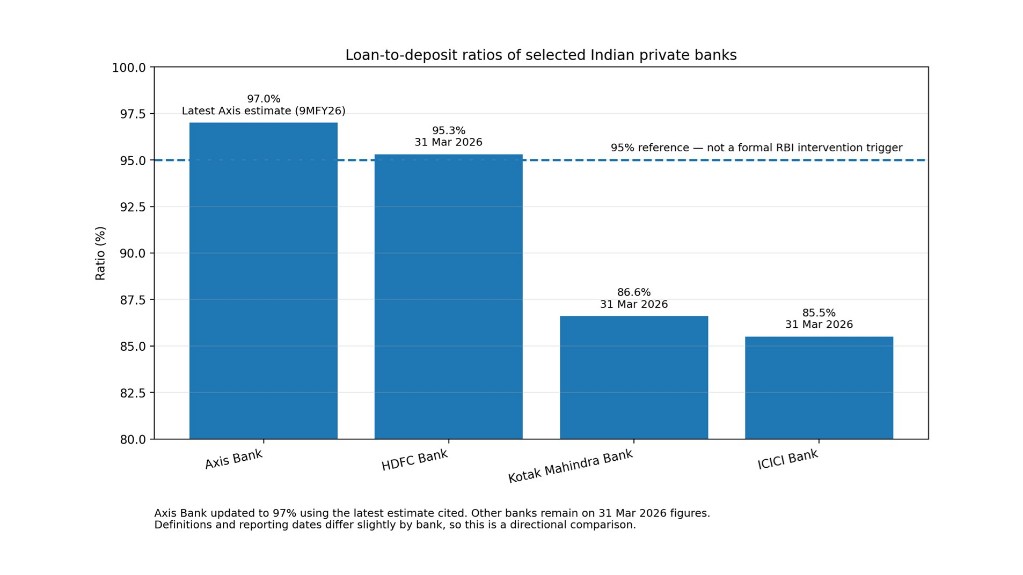
The constraint is funding. Deposits grew 6 per cent in the quarter, far behind the 19 per cent rise in domestic loans.[1] Fitch estimated that Axis’s loan-to-deposit ratio had already climbed to 97 per cent after nine months of FY26 from 94 per cent in FY25, and said it could rise further as the bank expands its deposit franchise.[6] Axis reported a net interest margin of 3.46 per cent, but competitive funding costs and deposit repricing have been identified as sources of margin pressure.[3, 7] Fast loan growth can support interest income; it can also force the bank to pay more aggressively for the deposits needed to fund it.
Asset quality offers reassurance, but regulatory change raises the burden of proof
Asset quality offers reassurance, not proof of a step-change. Gross non-performing assets stood at 1.28 per cent at the end of June, compared with 1.23 per cent three months earlier.[1] The movement was small, and no material deterioration appeared in the quarter, but it does not establish that the 44 per cent reduction in provisions came from a broad improvement in new delinquencies, recoveries or loan performance.[1, 2] The current result therefore supports a cleaner reported quarter without yet establishing a structurally lower credit cost.
That distinction will become more important as India changes the way banks recognize expected losses. The Reserve Bank of India issued final directions on April 27 covering asset classification, income recognition and provisioning, with an expected-credit-loss model replacing a system based mainly on losses that had already occurred.[8] Axis has previously said it strengthened provisioning policies, raised its provision coverage ratio from 69 per cent to 72 per cent and built more than ₹12,000 crore of additional non-NPA buffers.[9] But the June-quarter disclosures do not quantify how the new framework will affect future earnings or capital. A profit increase driven by lower provisions is less informative when the regulatory basis for future provisions is itself changing.
The next two quarters therefore have a more demanding task than repeating a profit beat. Net profit must begin to track net interest income and operating-profit growth rather than depend mainly on another decline in provisions. Other income must return to growth, or at least stop offsetting lending revenue. The 3.46 per cent margin must hold while deposits catch up with loans. And the 1.28 per cent gross NPA ratio must be accompanied by evidence that slippages, recoveries and coverage justify a lower credit charge.[1, 2, 3]
Axis has already delivered the easier part: a quarter with stronger interest income and no new balance-sheet shock large enough to overwhelm it.[1] What remains unproven is whether the bank can produce comparable profit growth after the prior-year charge disappears from the comparison, treasury income remains exposed to markets and deposit funding becomes more expensive.[1, 5, 6, 7] The pressure now sits on Axis Bank’s operating line, not its reported net profit.