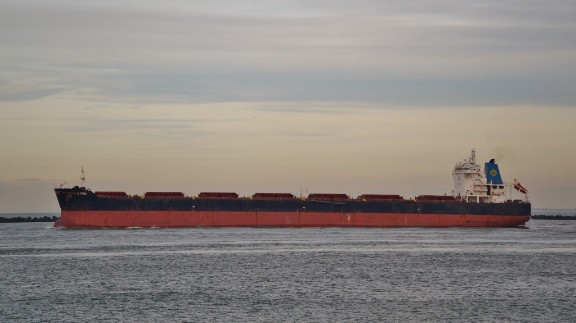
Three Indian sailors died after the US military struck a tanker in the Gulf of Oman, a detail confirmed only after they had first been reported missing and then counted among the dead three Indian sailors killed. The strike did not hit the bridge or the deck. It hit the engine room.
The US Central Command says an aircraft fired precision munitions into that compartment after the crew repeatedly failed to follow directions. Washington’s account treats the sequence as procedural: instructions issued, instructions ignored, force applied. What it does not resolve is why compliance has become the hinge on which civilian shipping now turns.
The tanker, identified as Settebello, had been accused of attempting to transport oil from Iran in violation of an American blockade. That blockade exists because Tehran effectively closed the Strait of Hormuz, a corridor through which some 20% of the world’s oil and gas supplies are transported. The chokepoint is not theoretical; it is operationally shut, and enforcement has moved from warnings to impact.
Compliance has shifted from procedure to a condition that determines survival at sea
The pattern is not isolated. Days earlier, US forces hit the Marivex, another tanker with an Indian crew, after it too failed to comply with US instructions. Both vessels flew Palau flags. Both carried Indian seafarers. Both became targets once they crossed a line defined not by ownership or nationality, but by movement.
The consequence lands unevenly. On the Marivex, all 24 crew were rescued by Omani forces. On Settebello, 21 were rescued, leaving three dead. The distinction is not moral or legal; it is mechanical. Where the munition lands determines who lives.
India has reacted at the diplomatic level, summoning the deputy head of the US mission in Delhi, while its shipping minister called the deaths “deeply unfortunate” and said the bodies would be brought back. The language is measured. The exposure is not. This is the second vessel with Indian crew attacked by the US this week.
The disagreement is not over facts but over the threshold at which force is used
The Indian government has insisted that “targeting of commercial shipping and civilian infrastructure in the region must end”. That position collides directly with the operational logic of the blockade, which treats non-compliance as sufficient condition for disabling a ship. The disagreement is not over facts; it is over thresholds.
Seafarers and their representatives are less guarded. Manoj Yadav, of the Forward Seamen’s Union of India, said he “refused to believe” that the US lacked information on who was aboard. He argued that detaining ships was a viable alternative if they did not comply. His objection is not to enforcement, but to method. It implies that the current method is a choice.
The choice is being exercised at scale. Since April 13, when the United States began a blockade, US forces have disabled eight vessels and redirected 134 others. Each intervention reinforces a system in which passage through Hormuz depends either on compliance with US directives or, as reports indicate, payment of a toll to Iranian forces for safe passage through a near-standstill in traffic. Neutral transit has disappeared.
Economic effects now reinforce the physical closure of the strait
The economic effect is immediate. Brent crude prices have risen above $90 a barrel, feeding through into freight, insurance and food costs that may increase food prices. Insurance itself has broken: it is unavailable or prohibitively expensive, while seafarers are unwilling to make the journey. The strait is closed not only by missiles and munitions, but by contracts that no longer clear.
India sits at the center of that closure. Around half of its crude oil imports travel through Hormuz, and it imports 90% of its oil. The war has exposed how tightly its energy security is tied to a single corridor. Each strike on a tanker carrying Indian crew converts that exposure into a political liability at home.
The military escalation continues. The US and Iran have exchanged strikes for a second consecutive day, straining a ceasefire reached in April, while President Donald Trump has threatened to hit Iran “hard” for delaying a peace deal. The war that began on 28 February after US and Israeli strikes killed Iran’s supreme leader has not settled into a stable equilibrium. It has shifted the burden onto the infrastructure that moves energy.
A system without shared strategy binds those who must operate within it
Inside Washington, the pressure is visible in a different register. Oil price sensitivity is explicit: the president is extremely sensitive to changing stock and oil prices. The administration is reconsidering its plans in light of the domestic economic impact, with economic fears creating incentives to pull the plug on operations. The war has no clearly defined endgame that the administration articulated. The enforcement mechanism does.
That mechanism now binds three actors who do not share a strategy: the US military enforcing a blockade through strikes, Iran restricting passage through threat and toll, and India supplying crews to ships that must navigate between them. The system functions only if compliance can be assumed and civilian status can be separated from strategic cargo. Neither assumption holds.
The result is already visible in the engine room of Settebello, where a compliance failure became a terminal event. The blockade treats movement as intent, the strait treats passage as permission, and the men who crew the ships sit at the intersection of both, carrying passports that neither system recognizes when the instructions stop being followed.