Cboe Volatility Index hit two-month highs this week even as major averages swung sharply from day to day, including strong gains on Thursday. The divergence matters because the selling has not been random. Technology shares have led the declines, the same sector that drove indexes higher in the rally from the March lows. The stocks that carried the market up are now carrying its uncertainty.
That uncertainty sits uncomfortably beside the story investors have spent months telling themselves.
Investors remain wary of an overheated rally amid soaring optimism about AI-driven profits, even as developments in the Middle East war and their effects on energy prices and inflation threaten to complicate the outlook. The market is not debating whether AI spending is real. It is debating whether future earnings can outrun a changing cost of capital.
The speed of the previous advance helps explain why the question has become urgent. U.S. equities staged a powerful ceasefire-driven rebound in April, with the S&P 500 gaining 10%, the Nasdaq surging 15%, and the Russell 2000 rallying 10%, while all three reached new all-time highs. Yet nearly all of the S&P 500’s gain arrived in two brief windows around ceasefires involving Iran, Israel and Lebanon. Markets climbed, but the climb rested on remarkably narrow foundations.
The concentration became even more visible beneath the index level. Semiconductors led the rally; the SOXX ETF gained 40% during a 17-day winning streak. At the same time, the equal-weight S&P 500 lagged the cap-weighted index by nearly 4.5% in April, evidence of what the source describes as narrow, mega-cap-concentrated breadth. A market driven by a handful of winners becomes unusually sensitive to any factor that changes how investors value distant earnings.
The rally narrowed as valuation risk moved back to the centre of the market
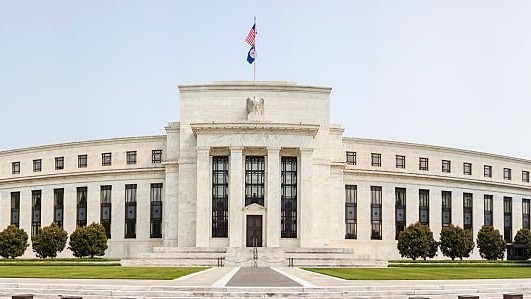
That factor increasingly looks like interest rates. U.S. consumer inflation in May increased at its fastest pace in three years. Combined with recent solid employment data, the figures have led investors to think the Fed will focus on containing inflation, potentially leaning more toward rate hikes. The institution expected to provide relief to valuations is instead being discussed as a possible source of pressure.
Officially, the Fed is widely expected to hold rates steady when it delivers its monetary policy statement on Wednesday. Unofficially, investors are focused on what comes after. Fed funds futures suggest expectations that the central bank will increase rates by year-end. Goldman Sachs has already shifted its own timetable, with its forecast for the first Federal Reserve rate cut pushed to 2027. The gap between a rate hold today and a market preparing for tighter conditions tomorrow is where much of the tension now resides.
The reason technology stocks have become the pressure point is mechanical rather than emotional. Growth stocks, particularly high-multiple technology companies, are valued on the present value of expected future earnings. That present value is calculated using a discount rate, and the discount rate rises with the interest-rate environment. When expected rate cuts move further into the future, the discount rate remains elevated for longer, compressing valuations on long-duration growth stocks even if nothing changes in the underlying business. That logic helps explain why U.S. technology stocks fell sharply after stronger-than-expected payroll data.
Investors are therefore listening as closely to the Fed’s language as to its decision. “The biggest thing is will the Fed hold, and what's the language around it?” said Marta Norton of Empower. Investors also want to learn Warsh’s policy goals and how he might seek to reshape the Fed. The question is no longer only where rates sit. It is how the institution intends to communicate uncertainty.
Markets may be adjusting to a world with less guidance and more interpretation
That matters because communication itself may be changing. Warsh has expressed a desire to pare the Fed’s $6.7 trillion balance sheet, a move that could cause ripples in markets. He may also seek to change the way the Fed communicates or provides policy guidance. Marvin Loh of State Street argued that “Trying to understand the reaction function of this new administration at the Fed is going to be key,” warning that a hawkish hold could surprise the market.
The most consequential risk is not necessarily a rate increase. It is reduced visibility. Jeff Given of Manulife Investment Management put the issue plainly: “If we are more data dependent and we're not getting visibility from the Fed of what they want to do”, then every economic release gets more attention and can generate more volatility than markets have seen in recent years. A market concentrated in technology, priced on distant earnings and already showing signs of strain does not need higher rates to become unstable. It only needs investors to lose confidence that they understand the rules under which those earnings are being valued.
That is the crack running through the current rally. The apparent strength of AI-linked technology shares rests not only on billions flowing into infrastructure and data centers but on an assumption that investors can see the path of monetary policy well enough to price future cash flows with confidence. Information technology and communication services continue to benefit from billions of dollars flowing into AI infrastructure, yet markets increasingly expect higher rates by year-end, inflation is accelerating, and the Fed’s $6.7 trillion balance sheet itself may be subject to change. The market has spent months pricing the earnings power of AI; it is only now confronting the possibility that the harder variable to value is the Federal Reserve.