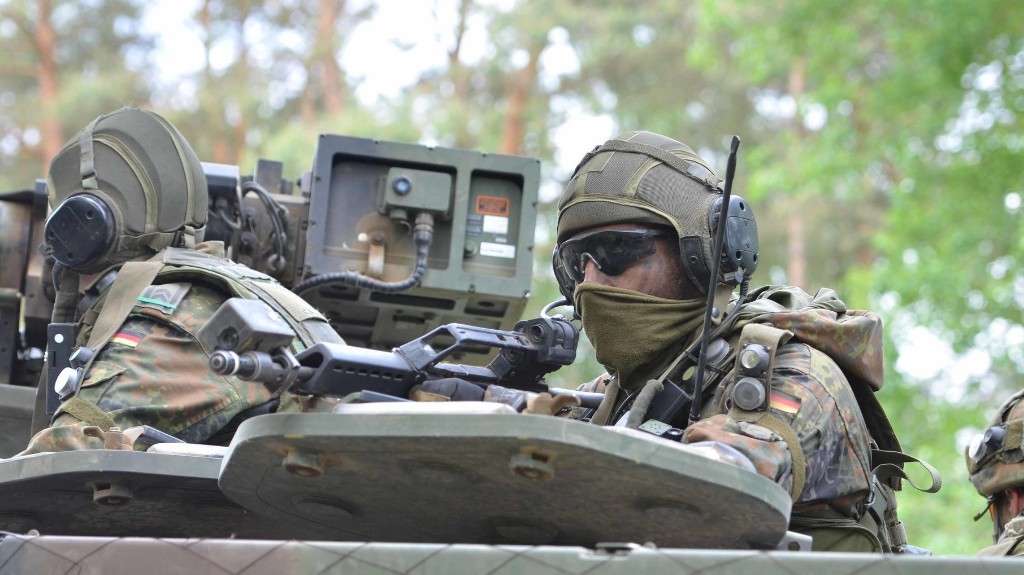
Ammunition for a howitzer sat on display during NATO training at a German army base in Munster in May 2022, as 7,500 soldiers from nine nations took part. Three years later, Germany is no longer debating whether it should rearm. Berlin has pledged to become a more powerful military force inside NATO, and its ambassador in Washington says the country is ready to assume greater responsibility for European security. The speed of the political shift is striking. The harder question is whether Germany can turn intent into power.
The country itself admits why the change became unavoidable. "Russia's illegal war of aggression has shaken old certainties in Europe and Germany as the international rules we have relied on are being challenged," Hanefeld said. He added: "This changes the strategic environment we operate in." Germany's response is sweeping. It has decided to become Europe's strongest conventional army, well anchored in NATO, as an ongoing commitment.
That ambition collides with the country's own history. The shift marks a historic turn for a state whose postwar military identity was built around restraint. West Germany was allowed to rearm only within a Western alliance framework, joining NATO in 1955 and building the Bundeswehr as a force embedded in collective defence rather than independent power. After reunification, Germany relied heavily on the U.S. security umbrella and often missed NATO spending targets, prompting complaints that Europe's largest economy was not pulling its weight.
Military ambition now confronts the limits of institutions built for another era
Then the assumptions underneath that model broke. Russia's full-scale invasion of Ukraine in 2022 forced Berlin to rethink its posture. Olaf Scholz called the shift a "Zeitenwende," a turning point that his successor is now trying to make permanent. Merz is seeking a long-term military buildup, while Hanefeld acknowledges that the transformation does not come easily given Germany's history. That may prove an understatement.
Germany has already spent heavily. Scholz announced a EUR 100 billion special fund in 2022 to modernise the Bundeswehr. Yet progress has been uneven and slower than initially anticipated. Major procurement milestones have been achieved, including commitments for F-35 fighter jets, Chinook helicopters, air-defence systems and ammunition stockpiles. But much of the fund remains tied up in long-term procurement programmes that have not yet translated into substantially improved operational readiness.
The bottleneck is structural. Persistent equipment shortages, procurement delays and difficulties recruiting and retaining personnel remain unresolved. Institutional and bureaucratic obstacles within the defence acquisition system have historically slowed delivery, and there is limited evidence those structural issues have been fully addressed. The result is uncomfortable: the gap between declared intent and actual operational capacity is significant, and converting money into deployable capability will take years.
Meanwhile, NATO is raising the bar. All NATO members have agreed to spend 5 per cent of GDP on defence and security by 2035. Leaders say the pledge requires at least 3.5 per cent of GDP in core defence spending, alongside up to 1.5 per cent for security-related expenditures. Germany is moving in the opposite direction from where it stood for decades, yet it still has ground to make up: military spending reached 1.89 per cent of GDP in 2024, below the world average of 2.20 per cent.
The pressure does not end with budgets. Germany's rearmament is unfolding as relations with Washington grow more brittle. Public friction between Trump and Merz has complicated NATO politics, and a U.S. defence expert warned the dispute could complicate critical decisions on deterring Russia. The quarrel widened after Merz criticised Washington's handling of the Iran war, saying the United States was being "humiliated" by Iran's leadership. Trump fired back by accusing Merz of being soft on Iran's nuclear programme, later threatening to review possible U.S. troop reductions in Germany.
That threat lands on an old dependency that Germany is trying to escape but has not escaped yet. Mark Montgomery said Merz was wrong to speak that way about Trump at a moment when Germany needs Washington's support. Germany wants to become Europe's strongest conventional army. It also wants that army to remain firmly anchored inside NATO. Those ambitions are compatible only if the alliance remains politically cohesive.
Economic weakness risks becoming the hidden constraint on strategic power
The economics are no easier. The DIW forecasts that the United States will continue to post growth of just over 2 per cent while the euro area's outlook is significantly weaker. The gap reflects energy as much as military power. The U.S. has become one of the world's largest exporters of liquefied natural gas and benefits from higher gas prices, while Europe has to import its energy. Russian gas supplies were cut off, forcing Europe to look overseas for new deliveries, and Europe does not produce enough energy itself.
Germany is therefore attempting something more difficult than rearmament. It is trying to build Europe's strongest conventional army while relying on imported energy, navigating tensions with the country that still underwrites European security and fixing a defence bureaucracy that has struggled to convert money into military capability. The gap between declared intent and operational capacity remains significant. That gap is not a future risk. It is the condition Germany is rearming inside today.