
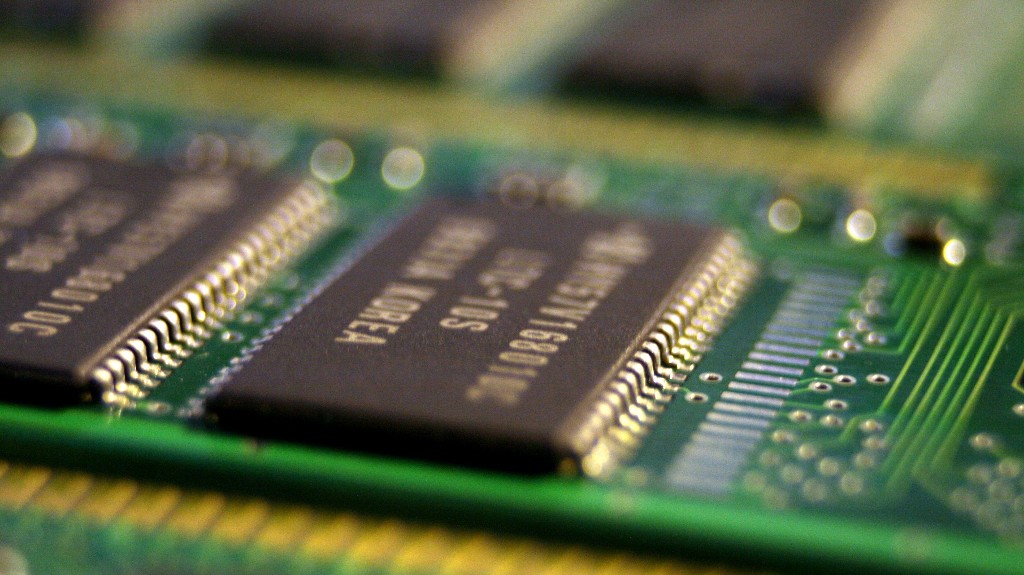
The AI buildout has turned memory chips from commodity parts into infrastructure capacity
The spending behind that repricing has reached levels that no longer resemble a normal procurement cycle. Microsoft, Google, Amazon and Meta are on track to spend more than $700 billion this year alone on the physical backbone of the AI economy. That exceeds the inflation-adjusted cost of landing 12 men on the moon, and Wall Street analysts expect the figure to top $1 trillion in 2027. The largest technology companies are not buying speculative software; they are securing power, reserving GPUs, building data-center shells, and negotiating supply agreements years ahead of deployment. That timetable has transformed memory from a commodity purchased at the margins of the cycle into infrastructure capacity locked in before factories even come online.
The clearest evidence sits inside Micron’s order book. Its entire 2026 supply of high-bandwidth memory chips is already sold out, while its next-generation HBM4 products are now in production. Customers racing toward artificial general intelligence have committed to longer-term data-center investments that triggered a sharp rise in demand for advanced memory and storage. Hyperscalers are no longer purchasing quarter to quarter because the hardware stack itself has changed. Memory now accounts for roughly 50% of the total bill of materials in XPU development, turning DRAM and NAND into strategic choke points rather than interchangeable components.
That bottleneck has spread through the entire electronics chain with startling speed. DRAM prices have surged as much as 180% since the Lunar New Year, while NAND prices climbed 246% from the start of 2025 through December. Buyers who lost contracted supply access then absorbed an additional 50–100% in weekly price spikes. The combined effect leaves buyers with little recourse because memory manufacturers have redirected capacity toward AI servers at the expense of nearly every other category of electronics. Supply has been squeezed away from flash chips used in smartphones and USB drives, and smaller hardware vendors are already struggling to secure inventory before prices rise again.
The redistribution of semiconductor capacity is beginning to reshape consumer markets
The consequences are beginning to appear in consumer markets that powered the last semiconductor expansion. PC shipments for the first quarter of 2026 are now expected to exceed earlier forecasts as manufacturers rush products out the door before memory costs fully reset upward. Smartphones face the opposite trajectory. The market is forecast to decline 6.8% as memory prices climb and smaller vendors struggle to secure or pay for adequate supply. The AI boom is effectively reallocating semiconductor capacity away from mass consumer electronics and toward a narrower group of companies wealthy enough to sign multi-year infrastructure contracts.
That redistribution of leverage explains why investors have stopped treating memory manufacturers as cyclical laggards. Industry analysts now describe competition in HBM as a shift from market share to profitability. The largest gains no longer come from flooding the market with supply; they come from rationing the right capacity at the right moment. The imbalance supports premium pricing and improves revenue predictability, while hyperscalers’ continued capital spending on AI infrastructure keeps demand locked in years ahead. Micron, once discounted for its volatility, now trades at 8.42 times expected earnings, still below broader technology indices even after the rally, because investors increasingly believe these earnings resemble utility cash flows more than commodity profits.
The market’s enthusiasm also reflects how few companies can actually manufacture advanced memory at scale. The capacity constraint is structural. SK Hynix was sold out of HBM3 through 2024 and nearly sold out through 2025, while Samsung, Micron and SanDisk have all signaled the same tightening conditions across the stack. Analysts tracing the supply chain increasingly separate the AI buildout into two economies: the hyperscalers that announce spending totals, and the memory manufacturers that determine whether those deployments happen on schedule. The memory makers tell us where the bottlenecks are forming, and those bottlenecks now shape the pace of the broader AI economy.
The industry’s oldest boom-and-bust dynamics are colliding with unprecedented AI demand
The shortage itself emerged from a collision between two forces that usually do not coexist. Economists and industry experts describe today’s market as the meeting point between the DRAM industry’s historic boom-and-bust cycle and an AI infrastructure buildout without precedent in scale. For decades, DRAM density doubled roughly every 18 months, driving relentless declines in cost per bit. The industry survived through oversupply, collapsing margins and periodic bankruptcies because manufacturers needed ever-lower costs to stay competitive. Suppliers that fell behind on cost reductions lost sales, then lost the cash required to finance the next generation of production. That logic depended on abundance. AI changed the equation by creating demand that absorbs supply faster than fabrication capacity can expand.
Manufacturers are responding with spending plans large enough to alarm their own shareholders. Micron has committed to roughly $200 billion of new capacity, betting that demand for DRAM and HBM will remain tight for years. Investors have welcomed the revenue outlook but recoiled at the cost. When Micron delivered extraordinarily strong guidance in March 2026, the stock still fell nearly 5% after hours because investors focused on the rise in factory spending. Semiconductor fabrication has always rewarded timing more than optimism. The same shortages that create pricing power today can destroy returns once too many factories arrive at once.
That risk falls unevenly across the industry. Micron still trails SK Hynix by six to nine months in qualification timing for each HBM generation, forcing it to capture later-ramp volume instead of the initial allocation. The delay limits revenue during the most profitable phase of each product cycle even as investors price the company like a dominant first mover. At the same time, the AI infrastructure race has become so capital intensive that even the largest customers are locking themselves into assumptions about demand years before they know whether those economics hold. The companies spending hundreds of billions on AI data centers increasingly depend on memory manufacturers staying disciplined enough not to flood the market later with excess capacity.
The companies benefiting from scarcity still depend on abundance arriving later
That discipline carries its own contradiction. Current shortages support pricing and margins, but future returns depend on how quickly Samsung and SK Hynix add capacity and how disciplined the industry stays. The memory producers now benefit from scarcity, while hyperscalers depend on abundance. Every new factory that eventually relieves AI bottlenecks threatens the margins currently financing the buildout. The same companies celebrated as the indispensable winners of the AI age therefore sit inside the oldest trap in semiconductors: spending aggressively into a shortage that markets already assume will last forever.
The imbalance already reaches beyond Silicon Valley trading desks. The global semiconductor ecosystem is experiencing an unprecedented memory shortage with knock-on effects expected to persist into 2027. Samsung co-CEO TM Roh called the shortage “unprecedented” as the race to build AI infrastructure consumes supply across the industry. Prices remain elevated not because memory suddenly became rare in geological terms, but because the world’s richest technology companies are absorbing production capacity faster than fabrication plants can physically expand. In that environment, the most valuable asset in the AI economy is no longer the processor that performs the calculation. It is the memory chip that allows the machine to remember.