
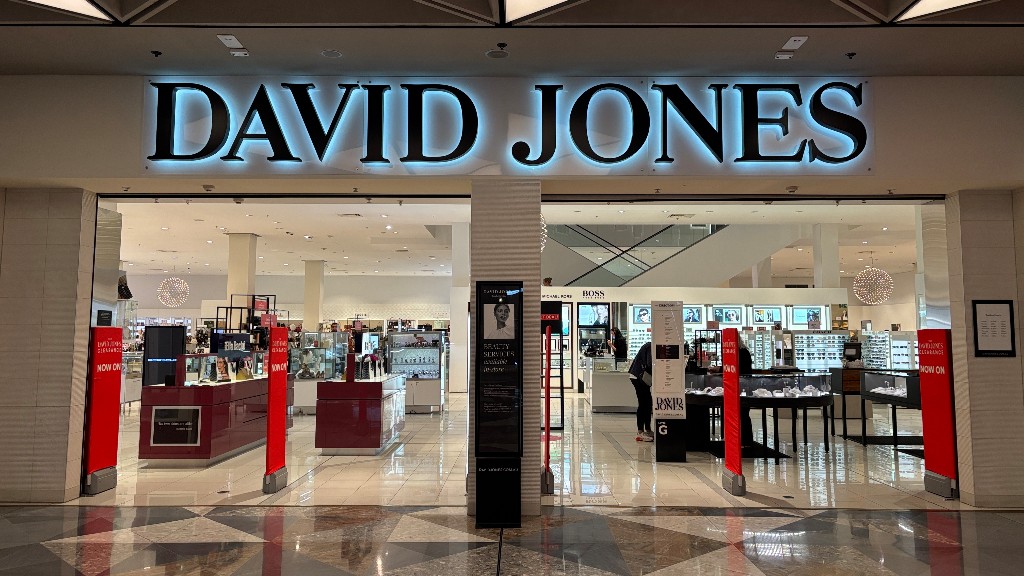
David Jones occupies about 200,000 square meters across 17 Westfield centers, paying $352 per square meter in gross rent against Scentre Group’s portfolio average of $942.[1] But Scentre has only about $30 million in bank guarantees protecting $45 million in annual gross rent, and David Jones has already stopped paying.[2, 3] A replacement lease negotiated at a higher rate would not compensate Scentre for an extended interruption if the new tenant's payments begin after that protection has been exhausted.
The guarantees provide the landlord with approximately eight months of rental coverage at the disclosed annual rate.[2] They are an established financial safeguard, not evidence that eight months of rent has already been collected. Scentre can draw against them to recover unpaid amounts, but the value remaining will depend on how much rent David Jones fails to pay and how much is subsequently recovered.[2]
Scentre had required those guarantees when Anchorage Capital Partners acquired David Jones in 2023.[4] The landlord confirmed that rent was current through September 30, 2026, but that October’s obligations had not been met.[2, 3] Scentre chief executive Elliott Rusanow also disclosed that an offer intended to preserve the retailer's operations had been rejected by Anchorage.[4]
Receivership shifts control of store exits away from the landlord
The decisions governing that outcome now sit partly outside Scentre’s control. Following David Jones’ entry into administration and receivership on November 5, Hilco Global appointed FTI Consulting to manage the retailer and evaluate store closures ahead of a possible sale. McGrathNicol was appointed voluntary administrator.[5, 6] David Jones had already sought changes to its lease arrangements and a reduction in weaker suburban locations, with a longer-term ambition to reduce its 38-store network to roughly one-third of its existing size.[7] Those plans have not become confirmed store exits, and the stores continue operating under the receivers.[6]
For Scentre, that creates a potentially expensive sequence of decisions. A store remaining open preserves the possibility of ongoing rental payments, subject to the obligations applying during the appointments. But as long as David Jones occupies the premises, Scentre cannot complete a replacement tenancy that requires that space. Conversely, surrendering a store could allow the landlord to pursue more lucrative tenants while removing the existing source of rent before replacement leases commence. Across 17 locations, the economic outcome will depend on which stores leave, when possession becomes available and how quickly those spaces produce new rental receipts.[1]
Australian administration rules add another consideration. Landlords can face restrictions on recovering premises or terminating leases solely because a tenant enters administration, while administrators can become personally responsible for certain rent obligations after an initial five-business-day period.[8] The particular treatment of David Jones’ leases under its concurrent administration and receivership will affect how Scentre collects rent during continued occupation. Payments that remain enforceable and collectible could preserve guarantee capacity for later stages of restructuring; prolonged nonpayment would consume it.
The exposure is manageable in the context of Scentre’s overall portfolio, but it is not negligible. David Jones represents approximately 1.8% of group gross rent and 3.6% of annualized funds from operations.[1] Those proportions limit the retailer’s direct importance to the entire business, while identifying the earnings exposure if rental collections deteriorate. A temporary interruption across some locations would have a different financial consequence from a prolonged failure to collect the full $45 million annual gross-rent contribution.[2]
Higher rents are possible, but converting department-store space takes time
Scentre has a credible alternative to prolonged dependence on David Jones. Its existing department-store leases generate considerably less rent per square meter than the wider portfolio, leaving scope to improve the use of space when it becomes available.[1] The landlord has already reduced David Jones’ footprint at three destinations to introduce other retail concepts.[9] At Westfield Burwood, premises formerly occupied by the department store were converted for Aldi, JB Hi-Fi, Nike and Rebel. The changes helped support a reported 9.3% increase in visitation.[10, 11] At Bondi Junction, another conversion introduced Virgin Active and Rebel into former department-store space.[10, 11]
Those projects establish that Scentre can attract alternative occupiers to space previously controlled by David Jones. Yet Burwood’s reported 9.3% improvement concerns customer visits, not the cash collected during conversion or the net rental return after redevelopment expenditure.[11] A retailer can attract more visitors and still require a period of construction, fit-out or other work before paying rent. In a negotiated conversion, Scentre can coordinate changes with an existing tenant; during receivership, decisions about which David Jones stores will be retained or surrendered depend on the restructuring process.
Broader leasing conditions strengthen Scentre’s position once those decisions are made. The group reported 99.8% portfolio occupancy in August and completed 1,401 leasing transactions during the first half of 2026, achieving average re-leasing spreads of 3.7%.[12] High occupancy and positive rent increases on completed leasing transactions provide evidence of tenant demand. They support the possibility that former David Jones space could command better terms, particularly where multiple retailers replace a large department-store tenancy. They do not, by themselves, determine the time required to convert substantial areas of retail floor space.
Scentre's prospective benefit comes from replacing historically inexpensive occupancy with new leases that generate higher income. But the benefit begins when replacement tenants actually start paying, rather than when David Jones announces closures or when Scentre identifies interested retailers.
Nor does the wider portfolio's strong occupancy necessarily eliminate that problem. Scentre's reported 99.8% occupancy reflects the position before the receivership, when David Jones remained an operating tenant.[6, 12] Maintaining a high overall occupancy figure would not alone establish that rents from the affected locations are being collected. Store-level rental receipts and replacement commencement dates will be more informative than the portfolio-wide occupancy rate during the restructuring.
Continued trading could preserve rental income while delayed replacement leasing exhausts security
The timing could also favor Scentre. If FTI maintains trading at the more viable stores and those occupancies continue generating collectible rent, the guarantees may be preserved rather than rapidly depleted. Selective surrender of weaker locations could then give Scentre access to space for which it has previously demonstrated replacement-leasing demand.[6, 10, 11] Under that outcome, the landlord could avoid a substantial income interruption while gradually increasing the contribution of former department-store premises.
The more adverse outcome requires several developments to occur together. David Jones would need to leave or stop paying for occupied space, Scentre would need to rely on a finite guarantee balance, and new tenants would need to begin paying too late to replace the interrupted receipts. A drawn guarantee would compensate for rent already unpaid, but it would also reduce the security remaining against subsequent defaults. If further unpaid obligations outlasted the available protection, the shortfall would then affect Scentre's rental collections.
A reduction in the approximately $30 million guarantee balance without corresponding restoration of rental payments would indicate that the initial protection is being consumed.[2] FTI's decisions about the 17 Westfield locations would then determine how much space Scentre may need to recover, whether David Jones continues occupying the premises and when any surrender takes effect.[5, 6] Confirmation of rent obligations during the appointments would clarify how much continued trading can contribute to collections.
Scentre would need to identify the space covered, contracted rent, commencement dates and any incentives or redevelopment commitments to demonstrate whether replacement arrangements can offset the interruption. Higher headline rent per square meter would be favorable, but the net benefit would depend on the amount of space actually leased, the period without payments and the cost of preparing it for new occupiers.
The nominal eight-month protection period places the central financial test around June–July 2027, depending on when guarantees are drawn and how ongoing obligations are settled.[2] Scentre's subsequent financial reporting will determine whether the restructuring has affected funds from operations or whether collectible rent and replacement leasing have preserved the income contribution.
FTI Consulting now influences when David Jones relinquishes the premises; Scentre must manage the rental consequences at the 17 Westfield locations.[1, 5] The landlord already has unusually low-rent space with potential for higher-paying uses and approximately $30 million of security against nonpayment.[1, 2] If the receivers' store decisions leave premises unavailable for replacement leasing until that security has been consumed, the resulting interruption will be borne by Scentre's rental collections, regardless of how much more valuable the space eventually becomes.
Cover photo: CC-BY-4.0 Nick-D