Administrative language for transfer has moved from the margins into the centre of Israeli politics
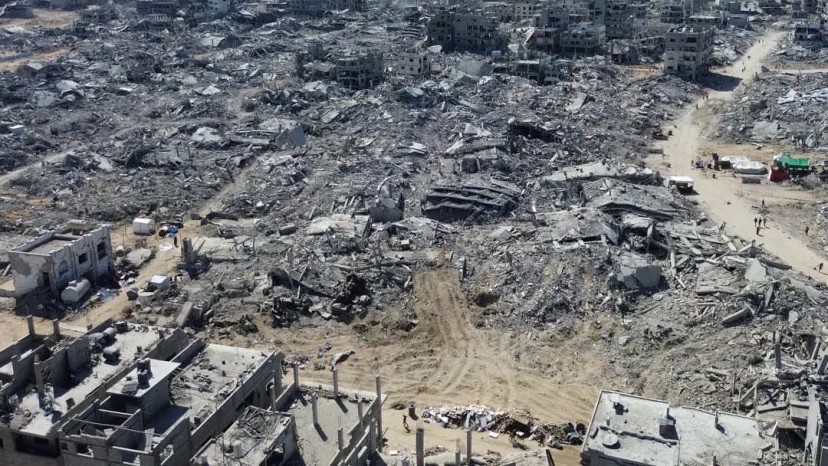
Palestinians lined up for food in Khan Younis on 27 May while Israeli ministers discussed the future of Gaza without them.Palestinians wait to receive food at a distribution centre in Khan Younis. At almost the same moment, Israel’s defence minister said he was committed to large-scale Palestinian migration from Gaza, describing a process that Israel Katz said would happen “at the right time and in the right manner”. The dissonance has become central to the war’s late phase: aid queues on one side, administrative language for population transfer on the other.
The policy no longer sits at the margins of Israeli politics. Last year Israel set up a bureau for “voluntary emigration” and eased travel restrictions for Palestinians seeking one-way journeys out of Gaza. Israeli officials now openly use the phrase “voluntary migration” to describe plans for large departures from the territory. Human rights lawyers inside Israel argue the term has become impossible to separate from coercion because conditions imposed on Gaza mean no departure can be considered voluntary. The legal stakes are stark: the forced transfer of civilian populations is a war crime and a crime against humanity.
Katz tied the migration plan directly to Israel’s military campaign against Hamas. He said the mass departure of Palestinians would go hand in hand with excluding Hamas from power, while insisting that Hamas would not rule Gaza “civilly or militarily”. Hours after mourners attended the funeral of Mohammad Odeh, Hamas’s armed-wing chief, killed in an Israeli strike, Israeli aircraft struck again in Gaza City. Israel says it continues its campaign to eliminate what remains of Hamas’s senior leadership. Each assassination narrows the space for negotiations while widening the political space inside Israel for more maximalist objectives.
Military operations increasingly function as signals in an electoral campaign shaped by war
That political space matters because Israel faces elections by the end of October. Mairav Zonszein of the International Crisis Group said Netanyahu and his allies would seek to demonstrate strength on the security front as ceasefires in Iran and Lebanon reduce other immediate pressures. She added that talking about ethnic cleansing in Gaza was not necessarily politically damaging inside Israel and “might even help”. The war has shifted from emergency mobilisation to electoral positioning, where military operations increasingly function as domestic political signals.
The ceasefire that once promised a pause now exists largely as an accounting dispute. Gaza’s Government Media Office said Israel committed 3,005 violations of the ceasefire over 227 days and that only 49,973 aid trucks entered Gaza out of 135,600 scheduled under the agreement, a 36% compliance rate. Israel counters that Hamas’s refusal to disarm remains the key obstacle. On the ground, the argument has produced paralysis rather than resolution. Parents in Gaza, according to Al Jazeera reporting, were reluctant to leave homes or tents with their children for fear of Israeli attacks.
Every military threat around Hormuz now reverberates through shipping markets and energy prices
The battlefield extends far beyond Gaza’s perimeter. Donald Trump’s latest remarks on Iran, Oman and the Strait of Hormuz underscored how far apart Washington and Tehran remain even as both sides continue negotiations. Trump warned Tehran he would “finish the job” if Iran did not agree to a deal, while the United States maintained a blockade on Iranian ports that has lasted more than a month. At sea, the pressure campaign has turned into an economic shock. Iran’s chokehold on the Strait of Hormuz has caused worldwide energy shocks, and oil and gas prices have spiked as shipping through the waterway deteriorated.
The strait carries approximately 25% of all seaborne oil and liquified gas transit. That statistic has transformed every military statement into a market signal. Prediction markets tracking whether Hormuz traffic would return to normal by July 31 fell from 68% to 62%, while traders priced in a significant likelihood of disruptions in shipping activity. An explosion on a tanker 60 nautical miles off Oman near Muscat deepened fears around maritime security after the vessel experienced an external explosion close to the waterline. Iran’s Revolutionary Guard then reinforced the pressure by declaring that the only safe shipping route was the one it authorised and warning that ships deviating from that path faced attacks and risks.
The longer the disruption persists, the more leverage accrues to actors outside the naval confrontation itself. Iran has already begun exploring more land routes after 3,000 containers became stuck in Pakistan. Maritime insurers, shipping firms and energy buyers now confront the same problem that defined the Tanker War of the 1980s, when Iraq attacked Iranian oil tankers to cripple Tehran’s oil-dependent economy. Back then, the conflict spread from the battlefield into freight markets, energy pricing and insurance premiums. The same chain reaction has reappeared, only this time it sits alongside simultaneous negotiations over Gaza, Lebanon and Iran’s regional role.
Reconstruction plans now coexist with open discussion of Gaza without Palestinians
The countries and companies positioned to benefit from prolonged instability are also absorbing the heaviest exposure. Iran’s ability to pressure global shipping rests heavily on Kharg Island, the terminal for nearly all Iranian oil exports with loading capacity of about 7 million barrels per day. The same infrastructure that gives Tehran leverage also concentrates vulnerability into a single export artery. Washington’s blockade strategy tightens that pressure further, but it also prolongs the price shock hitting energy consumers and shipping markets worldwide.
Inside Gaza, meanwhile, the idea of reconstruction has become detached from the question of who remains to inhabit it. Israel’s redevelopment plan states Gaza will be rebuilt “for the benefit of the people of Gaza”, even as the government promotes the prospect of Gaza without Palestinians. The contradiction no longer hides behind diplomatic language. It sits in plain view: a territory discussed simultaneously as a humanitarian catastrophe, a security threat and a redevelopment project, while the people waiting for food in Khan Younis continue to stand in line inside a war that every side claims is nearing its end.