Australia is simplifying a submarine plan whose underlying dependency is becoming harder to conceal
One of the biggest decisions that an Australian government has ever made now turns on whether American shipyards can do something they have never done.
Australia has abandoned plans to buy a new Virginia-class submarine and will instead take three “in-service” submarines, a decision Richard Marles framed as “placing ‘a premium on simplicity’”. The government had originally expected to buy one new and two secondhand Virginia-class submarines. Marles insists the change will make training and operations easier and cheaper for Australian crews in the early 2030s because they will not have to operate two different American-made submarines before the bespoke SSN Aukus model comes online in 2042. The logic is administrative. The constraint underneath it is industrial.
The first Virginia-class submarine is due to arrive in Australia in 2032, with another arriving every four years after that. Until then, Australia is extending use of 30-year-old Collins-class submarines, keeping the six Adelaide-built boats in service for another decade. Canberra is simultaneously buying $200mn AUD worth of MK-48 heavy torpedoes to strengthen those aging submarines before the nuclear fleet appears. Pat Conroy said the weapons would uplift “defensive and offensive capabilities” and later equip Australia’s future nuclear-powered boats. Australia is buying time as much as firepower.
The production bottleneck is no longer hypothetical because the American system is already struggling to meet its own needs
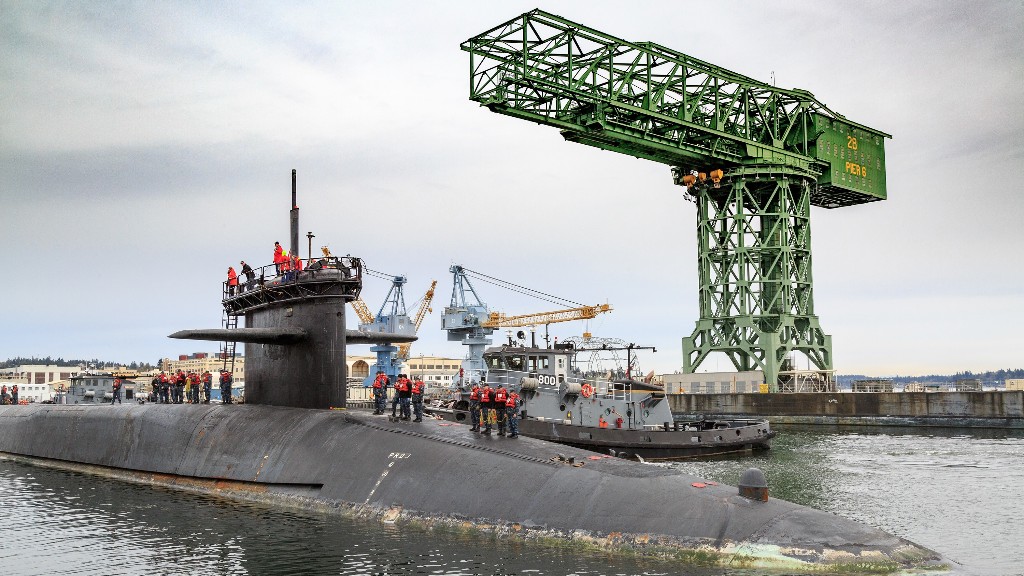
That would be less consequential if the American production line were stable. It is not. The US government is attempting to double the rate of production of the Virginia-class because Aukus depends on output the system does not yet have. American shipyards currently produce between 1.1 and 1.2 Virginia-class submarines each year. The deal requires 2.33 per year. The gap is not theoretical. The Congressional Research Service reported in January 2026 that although Virginia-class submarines had been procured at a nominal rate of two per year since 2011, the actual production rate has never reached 2.0 boats per year and has instead remained stuck near 1.1 to 1.2 boats per year since 2022, creating a growing backlog of submarines already ordered but not yet built.
The pressure is no longer confined to future delivery schedules. It is already visible inside the US Navy. One assessment described “a domestic industrial crisis” as the immediate threat to American undersea dominance, not foreign adversaries. A significant portion of the attack submarine fleet is currently sidelined by extended maintenance delays. The USS Boise reportedly waited more than seven years for repairs. The Columbia-class program, which carries Washington’s own strategic nuclear requirements, is running 12–16 months behind schedule. The same yards are expected to service American needs, reduce maintenance bottlenecks, build Columbia-class submarines and produce enough Virginia-class boats to supply Australia. Aukus sits inside that queue, not outside it.
Marles continues to argue that Australia has “a sense of confidence” production rates will rise where they “need to get to”. But even optimistic American timelines no longer match the political cadence of Aukus. Adm. Daryl Caudle told appropriators that shipbuilders General Dynamics Electric Boat and Newport News Shipbuilding would likely reach a two-a-year Virginia delivery rate by 2032. The US Navy’s broader “1+2+Sustainment” plan aims for three submarines per year by 2028 — one Columbia-class and two Virginia-class — yet current output still averages only 1.3 annually, constrained by workforce shortages, supply chain problems and production inefficiencies. Australia’s first Virginia-class boat is scheduled to arrive the same year the American system merely hopes to achieve the lower threshold of two-per-year production.
Australia is committing historic sums to a capability whose supplier remains structurally behind schedule
Canberra has nevertheless chosen to simplify around the dependency rather than reduce it. Marles described the revised purchase structure as “chasing simplicity”, while conceding there would be no “fundamental” shift in the cost of the agreement, estimated at at least $370bn. He also played down Aukus spending as 0.15% of GDP over the lifetime of the deal. Yet the surrounding defence budget tells a more restrained story. Defence spending for 2024-25 stands at 2.03% of GDP, rising marginally to 2.05% in 2025-26. One assessment noted that Donald Trump’s “upending of the world order has made no difference” to funding plans that increased combined spending across two financial years by only around 1%. The largest procurement in Australian history is advancing inside a defence budget that has barely moved.
That leaves Australia holding a peculiar position. It will become just the seventh country to operate a nuclear-powered submarine, but the first three boats delivered under Aukus are expected to be early-build, secondhand Virginia-class submarines that will already be more than 25 years old by the time they enter Royal Australian Navy service in the mid-2030s. Canberra is spending hundreds of billions to enter a club whose leading member cannot currently build enough submarines for itself, cannot repair its existing fleet on schedule and does not expect to reach even the lower production target until the same year Australia expects its first transfer. The structure underneath Aukus is not failing in secret. It is failing in public, at 1.1 submarines a year.