China is transforming maritime presence into a claim of jurisdiction
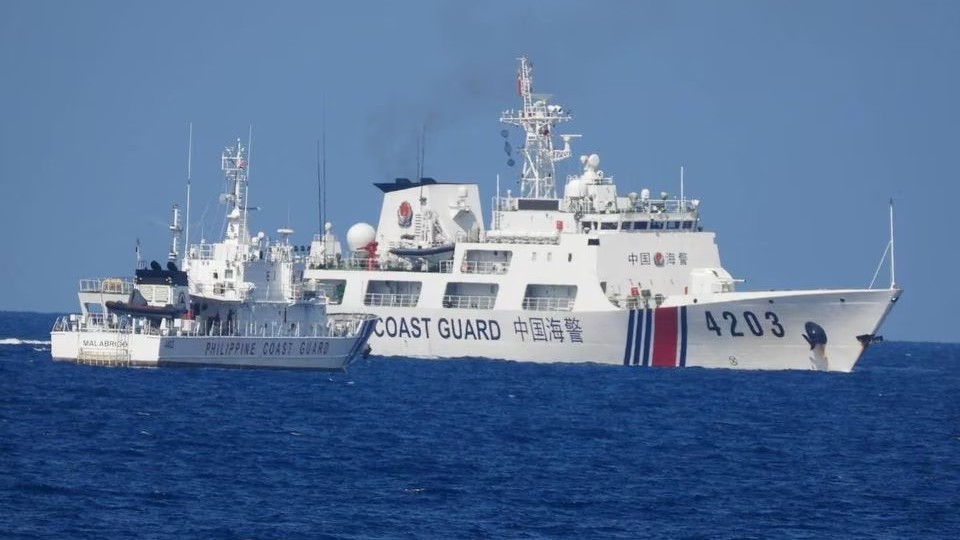
More than 100 Chinese navy, coast guard and other vessels were deployed across waters stretching from the Yellow Sea to the South China Sea and the western Pacific in the days after Donald Trump met Xi Jinping in Beijing. Yet when Beijing announced on Monday that it had carried out “law enforcement” patrols in waters east of Taiwan, Taiwan said it saw only two Chinese ships southeast of Orchid Island, and that they did not enter restricted waters. The gap between the scale of the deployment and the scale of the visible encounter matters. China is no longer using maritime pressure simply to challenge territorial claims. It is normalising a condition in which every negotiation, transit route and coast guard response in the western Pacific unfolds under the assumption that Chinese vessels are already there.
The immediate trigger was not a military exercise but a legal process. Japan and the Philippines said last week they would begin formal talks on delimiting the maritime boundary of their exclusive economic zones and continental shelves “in accordance with international law”. Beijing answered by declaring the talks “completely illegal, null and void” because they covered waters east of Taiwan, which Beijing views as its own territory. China’s Coast Guard then described its patrols as “a necessary action” in response to Tokyo and Manila “unilaterally announcing” the negotiations. A maritime boundary discussion between two US allies became, in Beijing’s telling, an infringement on Chinese sovereignty before a line had been drawn on any map.
That shift matters because delimitation is supposed to be procedural. It is the legal and cartographic process of defining a boundary between regions or countries. Beijing is treating the process itself as provocation. Tokyo’s response revealed the legal fault line underneath the confrontation. Chief Cabinet Secretary Minoru Kihara said any agreement reached by Japan and the Philippines would not be legally binding on “third parties” and therefore posed “no issue whatsoever under international law.” Japan is arguing that bilateral negotiations do not adjudicate China’s claims. China is arguing that the negotiations cannot even occur because the waters involved already belong to China through Taiwan. The dispute is no longer over where a maritime border sits. It is over who has the authority to discuss one.
Routine patrols are becoming instruments of administration
Taiwan understood the patrols the same way. Its foreign ministry said China has “no right to interfere” in Taiwan’s territorial sovereignty and maritime rights. Its coast guard condemned Beijing for claiming to conduct “law enforcement activities” near Orchid Island. The language is important. Law enforcement assumes jurisdiction. China is increasingly deploying coast guard vessels, not just naval assets, because coast guards transform disputed water into administrated space. A warship signals confrontation; a coast guard cutter signals governance.
The pattern has accelerated. Taiwan reports that Chinese warships and warplanes operate around the island almost daily, sometimes alongside coast guard ships. The PLA conducted a record-breaking level of air and maritime activity around Taiwan in 2025, sustaining an operational tempo that began after William Lai’s inauguration in 2024. That expansion did not stop at the Taiwan Strait. China’s military activity increased near Japan, in the South China Sea and beyond the First Island Chain, reflecting a broader increase in geographic reach. Last month, a Chinese coast guard ship approached close to the Taiwan-controlled Pratas Islands before leaving after a stand-off with Taiwan’s coast guard. Taiwan Defence Minister Wellington Koo responded by saying the military had a role to play alongside the coast guard and that the navy would provide “necessary assistance” under joint protocols. Taiwan is quietly collapsing the distinction between civilian maritime policing and military deterrence because Beijing already has.
Trade routes remain open even as the rules governing them begin to shift
The geography underneath these encounters carries global consequences. Twenty-four per cent of global maritime trade passed through these contested waters in 2023. An estimated $5.3tn worth of commercial goods transits the South China Sea annually. The economic pressure does not begin with a blockade or a battle. It manifests in the immediate costs of uncertainty that already reshape commercial behaviour. What began as territorial disputes over uninhabited territories has evolved into a strategic competition that could alter international trade patterns for decades. The crucial change is that China’s expanding maritime presence allows Beijing to contest not only sovereignty claims but also the legal assumptions that keep trade routes politically usable.
That is why the most revealing line in the confrontation may have come from Taiwan rather than Beijing. After ordering Chinese vessels to leave its waters, Taiwan’s coast guard warned that its vessel would “take necessary action in accordance with the law.” Both sides now describe contested water through the language of routine enforcement. Both claim legal authority. Both present escalation as administration.
The danger is not that the South China Sea suddenly erupts into open conflict. It is that the region’s commercial and legal architecture is being rewritten vessel by vessel while trade continues to flow through it. Beijing’s position already rests on a practical reality that grows stronger each time another coast guard patrol enters disputed water and leaves without consequence: the country able to maintain continuous presence increasingly defines what counts as normal. The $5.3tn moving annually through the South China Sea still depends on the assumption that global trade routes are governed by stable international rules; China is testing whether sustained maritime presence can replace those rules without ever formally overturning them.