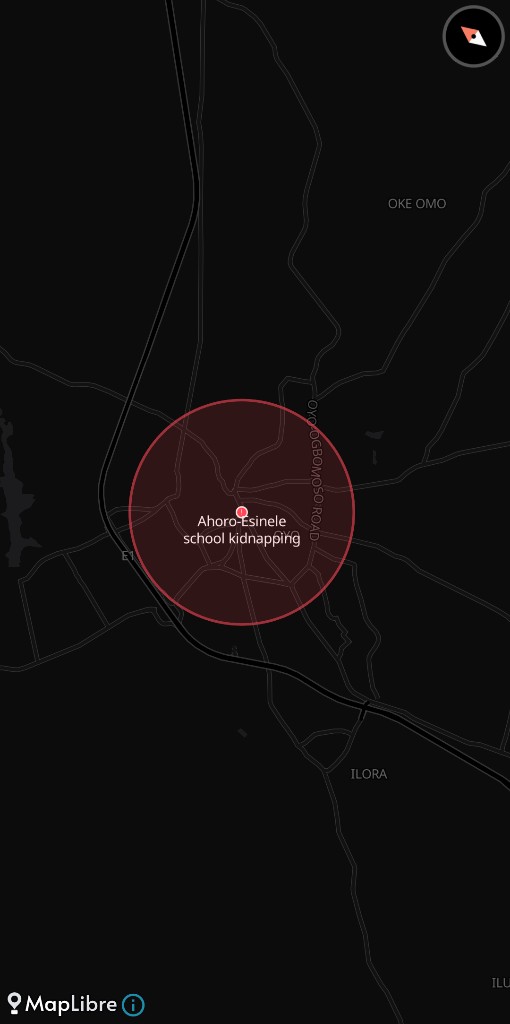
Click to load the interactive map
A video surfaced last week showing the abductors releasing footage of the principal of Ahoro-Esinele school, Alamu Folawe, filmed on her knees, asking for negotiation. “You don’t need force; all they have to do is negotiate with them and release us… we are in the cold, we are under the sun, we are under the rain,” she said. The appeal was not just for rescue but for a method—one that assumes the state no longer controls the terms.
Families watching that video had already been told that Oyo state authorities had assured them they were doing “everything humanly possible.” This failed to calm the public. The gap between promise and outcome now carries its own meaning, measured not in policy but in how long people wait without news.
For Ariyike Adeleke, whose 14-year-old son, Joshua Adeleke, was kidnapped on 15 May, the shock lay in geography. “I was surprised… I did not think it was possible for such to happen here,” she says. What changed was not the existence of violence but its location. Insecurity is not new in Oyo state, but the attack in Oriire is symptomatic of something moving.
Movement of violence redraws boundaries once assumed stable
That movement has direction. Bad actors who were flushed from northern Nigeria and the middle belt have decamped farther south. The displacement carries consequence because the south-west had enjoyed relative peace. The line between regions was never formal, but it was understood. It no longer holds.
Analysts are careful about what has—and has not—changed. Ladd Serwatt says “the significance of the Oyo attack lies less in the state suddenly emerging as a major conflict hotspot and more in the symbolic breach of safety in Nigeria’s south-west.” Symbolic breaches do not stay symbolic. They alter behaviour before they alter statistics.
The statistics, however, are already moving. Nigeria saw an increase in violence in 2025, part of a broader pattern in which Islamist militants are exerting growing military strength across regions. Incidents of ransom have jumped by nearly 195%. In 2024 alone, more than 9,400 people were killed in affected regions. The geography of that violence has been shifting even as attention has not.
Global attention lags as local realities accelerate
Global attention was fixed on Iran while violence, unrest, and instability continued to escalate elsewhere, largely out of view. The concentration of violence in the east and west of the continent has begun to diffuse in ways that make local assumptions obsolete. Oyo’s shock is the lag between reality and perception.
External partners are adjusting faster than domestic expectations. The US has urged its citizens to reconsider travelling to Nigeria, and authorised the departure of non-emergency staff from its embassy in Abuja, citing a “deteriorating security situation.” This comes despite an expanding security partnership in which Washington has been working with Abuja on counter-terrorism, intelligence sharing and training. Cooperation has not translated into containment.
The state’s response is measured not only against external warnings but against its own resources. Oyo State gets 12 billion naira annually in security funds, 84 billion in seven years. The number circulates locally because the absence it represents is visible. A principal on her knees. A husband who fell to his knees in tears when the state governor visited the town. The arithmetic does not reconcile with the outcome.
Negotiation replaces control as the state loses initiative
Critics have drawn that line bluntly. One claim circulating locally is that Governor Seyi Makinde can’t provide security for his people, that he is playing politics with the lives of his people. Whether or not the accusation holds, it reflects a shift: security is no longer judged by effort but by presence. Either the violence arrives, or it does not.
What has arrived is not just violence but negotiation as default. The abductors maintain contact; the kidnappers have been in contact with the Oyo state authorities. The hostage video prescribes terms. “You don’t need force.” The suggestion carries an implicit hierarchy: the state reacts, the abductors set conditions. That inversion does not require formal recognition to operate.
This is where the breach becomes structural. If actors displaced from the north can decamp farther south and impose negotiation on first contact, then the boundary that once separated “conflict zones” from “safe regions” has already dissolved. The system that assumed containment is now absorbing movement.
Cheta Nwanze states it plainly: “The Nigerian state is increasingly unable to fulfil its most fundamental duty: protecting its citizens.” The sentence reads like diagnosis, but in Oyo it functions as description. The state still issues assurances, still receives funds, still hosts partnerships. It no longer determines where violence begins or how it ends.