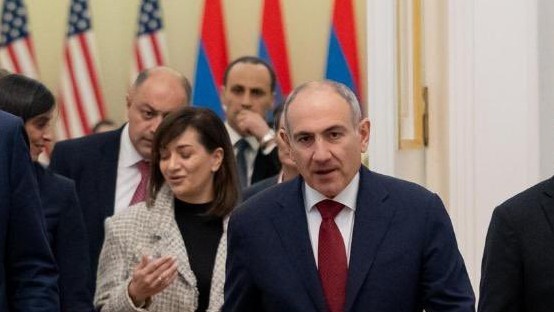
Samvel Karapetyan casts his ballot while campaigning from house arrest, after authorities detained him and charged him with calling for the seizure of power. The state has arrested opposition figures across his party on accusations ranging from vote-buying to attempts to overthrow the government. The election is already being decided in a narrower space than the ballot suggests.
The space for political competition has narrowed long before voters reach the ballot
That narrowing began in 2023, when Azerbaijan seized Nagorno-Karabakh and Moscow failed to intervene despite deploying peacekeepers. Many Armenians grew disillusioned with Russia as a security guarantor. The rupture did not stay symbolic. It prompted Pashinyan to suspend Armenia’s participation in the Russian-led CSTO, the most visible break in a relationship that had defined the country’s security posture since independence.
Moscow did not retreat quietly. In the run-up to the vote, it imposed trade restrictions on Armenian exports from fruit to brandy, and intensified economic pressure across key sectors. The pressure came with a message. Vladimir Putin warned that Armenia was heading down the same path as Ukraine, invoking a trajectory that ends in confrontation. Armenian officials say Russia has also attempted to influence the election through disinformation and by flying diaspora voters home. The instruments are familiar. The outcome is less so.
Economic pressure exposes how little the underlying hierarchy has changed
The sanctions have not yet bitten where Moscow aimed. These last-ditch measures have so far failed to dent Armenia’s economy. Pashinyan has invested heavily in Armenia’s regions, where his support remains strongest, buoyed by growth tied to an influx of Russian capital after the invasion of Ukraine. The paradox is immediate: the same war that loosened Moscow’s security grip tightened its economic one.
That dependence shows up in the numbers. Russia remained Armenia’s leading trading partner in 2025 even as bilateral trade volumes declined. Total trade fell to $6.7bn, nearly halving year on year, yet Moscow still accounted for more than 35.5 percent of Armenia’s foreign trade. China sits at 12.5 percent; the European Union at 11.8 percent. The contraction changed scale, not hierarchy.
It was not always contracting. After sanctions on Russia, Armenian exports tripled in 2022 and doubled again in 2023, even as political relations deteriorated. That expansion left Western partners questioning Yerevan’s compliance with sanctions regimes. It also created a structure that is difficult to unwind. Joining sanctions against Moscow would risk unprecedented economic downfall for Armenia, a constraint that survives any diplomatic pivot.
A westward political turn collides with an eastward economic reality
Pashinyan is testing that pivot anyway. His party platform no longer frames the country as reliant on Russia and instead emphasizes closer engagement with the European Union. Brussels has responded with an initial €50m support package to help Armenia withstand Russian economic pressure, and has largely brushed aside criticism of his increasingly personalized rule. Paris has gone further. Stéphane Séjourné said France will continue its support and maintain defence cooperation, insisting Armenia must be able to protect its territory.
The security guarantees remain uneven. The United States is the dominant global military power but not the primary actor in the Caucasus. Previous commitments have not always translated into concrete action. Washington stated it would not tolerate ethnic cleansing in Nagorno-Karabakh, yet after Armenians were cleansed there was no intervention and the US ambassador implicitly endorsed these actions by participating in an Azerbaijani tour. Azerbaijan, emboldened by Russian neutrality and Western ambiguity, continues to exert pressure. Armenia is shifting alliances without acquiring a reliable replacement.
The domestic cost of that shift is visible. Observers point to an increasingly personalised style of politics and what critics call growing authoritarian tendencies in a country that remains a rare democratic outlier in the region. Pashinyan has appeared erratic, publicly accusing refugees from Nagorno-Karabakh of having “run away” rather than fighting. Yet voters keep returning to him. Many continue to back Pashinyan because the opposition remains deeply discredited and tied to Russia. “People are choosing the lesser of two evils,” said Tatul Hakobyan. “The alternatives to Pashinyan are much worse.”
That calculation rests on an assumption that Armenia can separate its politics from its trade. The evidence runs the other way. Russia’s political and security presence has weakened, but it remains the country’s largest trading partner by a wide margin. The dependency is not abstract; it is denominated in export flows, in sectors Moscow can still throttle at will, and in a share of trade no Western partner currently matches.
The result is a government moving west under an economy still anchored east, backed by voters who distrust both directions. Brussels can offer €50m. Moscow still holds more than a third of Armenia’s trade, even after a collapse in volume. That imbalance is not a transition. It is the structure Armenia is voting inside.