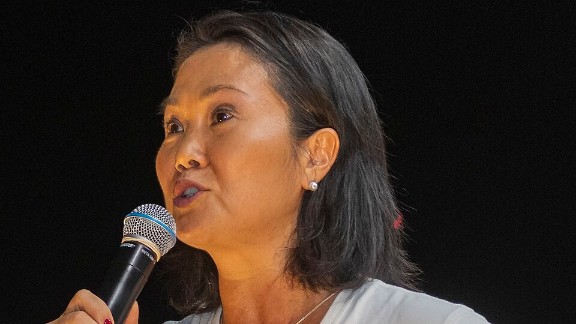
At 19, Keiko Fujimori was 19 years old when she made her international debut at a 1994 event as Peru’s first lady, stepping in after her mother separated from her father following a denunciation of corruption. It marked the beginning of Fujimori’s political life, not through election but inheritance, on the arm of a president whose name still divides the country.
Three decades later, at the age of 51, she is making her fourth attempt to win the presidency, after defeats in 2011, 2016 and 2021. She faces the leftist candidate Roberto Sánchez again, this time with polls showing her with a slight lead. In the first round, she came first with 17.2% of the vote, ahead of Sánchez’s 12%, a margin that says less about dominance than fragmentation.
Fragmentation has become the governing condition rather than an aberration
That fragmentation has already governed Peru. Eight presidents have cycled through power over the past decade, a churn that has turned the presidency into a temporary posting rather than an anchor. Policy uncertainty will remain high even after the runoff, Fitch Ratings says, because the next administration will confront long-standing governability challenges. The office Fujimori is seeking has lost the ability to hold what it promises.
She is running on the opposite claim. “We need order — order to live, order to invest, order to work,” she said in debate, reducing the choice to a binary: “Either we want chaos and disorder, or we restore order.” The pitch is simple enough to travel. It is also aimed at a country where the political system itself has refused to stay still.
Critics point to her role in that refusal. They say she shares responsibility for Peru’s political instability, the same instability she now offers to cure. The accusation does not rest on a single act but on accumulation — legislative obstruction, contested elections, a style of politics that treats institutions as terrain rather than constraint. It leaves her argument exposed to a contradiction she cannot outrun: the system she promises to stabilise has repeatedly destabilised around her.
Recalibration of tone acknowledges limits of confrontation without resolving contradiction
She has tried to adjust. During this campaign, she has projected a more reserved, calm image. “It’s true that we were confrontational, and we’ve corrected that,” she said, conceding tone if not substance. A political scientist, Julio Carrión, calls it “a more calculated effort to shake off that image” of permanent confrontation. The recalibration acknowledges that her previous approach won votes but not power.
The legal shadow that once threatened to define her candidacy has receded. She spent 13 months in prison while under investigation for corruption linked to Odebrecht, a charge she has repeatedly denied, before a court declared the case null and void in January 2025. She now claims ten years of political persecution. The case is closed; the perception is not.
The electorate she needs to persuade has already shown how little it trusts the process itself. The 2021 runoff was marred by allegations of voting irregularities, even as election monitors found no evidence of malfeasance. In 2026, 187 polling tables failed to install, forcing authorities to extend voting for about 55,000 electors into a second day. Those voters cast ballots after observing flash estimates, evidence that even the sequencing of information can move outcomes in a system this volatile. The mechanics of voting have become part of the contest.
Markets respond not to ideology but to the durability of governance
Markets have noticed before. When a leftist surge appeared likely in an earlier race, Peru’s dollar bonds due in 2051 fell as much as 2.24%. Price moves of that size do not come from ideology alone; they come from the expectation that the state may not be able to hold a line long enough for policy to matter. Investors react not to who wins, but to whether the winner can govern.
That is the constraint closing in on this election. Fujimori offers order in a system that has not delivered it to anyone who has held office in the past decade. Sánchez offers change in a system that has broken those who tried to impose it. Polls show them tied at 38% in the second round, a dead heat between two promises the state has not recently kept.
The unresolved condition is not the vote count. It is the capacity of the presidency itself. Peru has built a political cycle in which victory does not translate into control, and where the incentives of opposition outlast any mandate. Cleaning up corruption, salvaging the economy and restoring trust in democracy remain listed as tasks for the next president, unchanged by the succession of those who failed to complete them.
Fujimori’s campaign rests on a claim that order can be restored by winning power. The record suggests something narrower: power in Peru has not been sufficient to restore order. The office she is poised to occupy has already consumed eight presidents in ten years; the risk is not that she cannot win it, but that even if she does, it will not hold her.