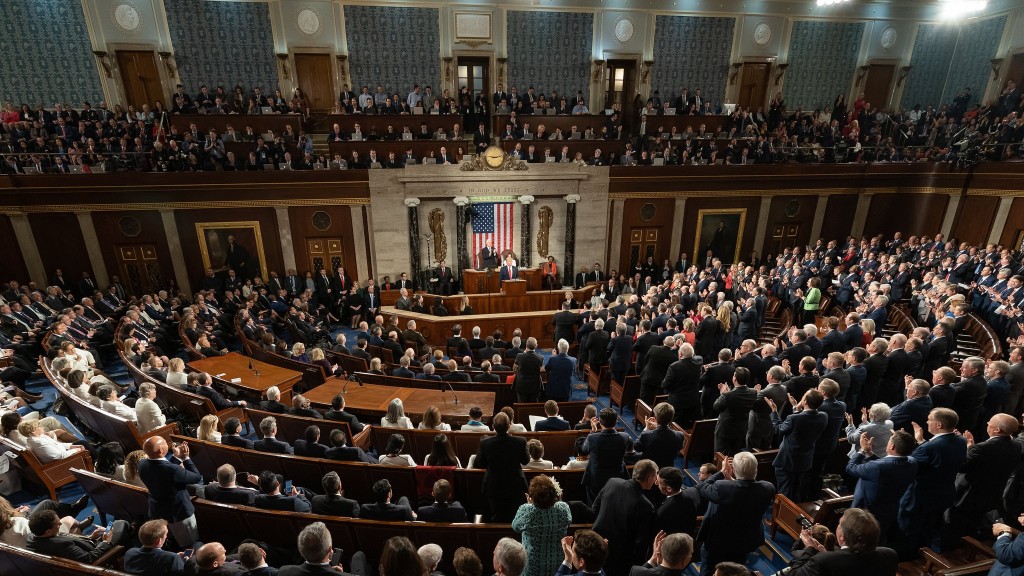
The mechanism that forced the vote was once a procedural relic. Now it is how the House moves when leadership will not.
Supporters of the Ukraine bill assembled 218 signatures on a discharge petition, a tool that allows a majority of the House to effectively bypass leadership. The result was a 226-195 vote that broke, for the second time in a week, from Donald Trump’s handling of foreign policy. The day before, the chamber approved a war powers resolution aimed at halting US military action against Iran. The sequence matters less for what it passed than for how it passed. Authority is migrating inside the legislature, one procedural end-run at a time.
Procedure becomes the arena where strategic authority is contested
The bill itself is not subtle. It seeks to cement US assistance for Ukraine by providing more than $1bn and would make another $8bn available through loans. Gregory Meeks framed the choice in terms that strip away process. Would it help Ukraine negotiate from a position of strength or help Russia outlast American resolve? The language assumes a binary that Congress can influence directly. The vote suggests a majority believes it still can.
That assumption sits uneasily with how the aid now moves. After the suspension of new US military donations in 2025, European partners began purchasing American weapons and routing them through NATO’s Prioritized Ukraine Requirements List. Under that system, allies make financial contributions to acquire weapons against a list agreed with Washington and NATO command. By mid-October 2025, seven European countries had contributed more than $2bn. The United States remains central — as supplier, as coordinator — but no longer singular. The money still passes through American industry even when the decision does not originate there.
A system designed to sustain flows begins to dilute control
This shift has not resolved who is in charge of the architecture. As of June 2025, it remained unclear whether NATO would fully take over the Ukraine Defense Contact Group or only assume technical roles through a replacement mechanism. The Ramstein format has still been operational, but US engagement remains uncertain. The system functions. It does not settle. Each layer added to keep weapons flowing has also diluted the point at which political control can be exercised.
Congress is trying to reassert that control through volume — more funding, more sanctions — even as the underlying system has learned to operate around moments of hesitation in Washington. The sanctions regime has already redrawn the economic terrain. US-Russia trade has fallen fifteenfold, from $36bn in 2021 to $2.48bn in 2024, after more than 6,400 sanctions targeted individuals, firms and sectors. The economic break is not prospective. It is complete. What remains is not whether pressure exists, but whether it still moves the outcome it was designed to change.
Inside the House, that question has become procedural before it is strategic. Members have used the discharge petition this Congress to pass bills on issues far removed from Ukraine, from releasing files on Jeffrey Epstein to extending healthcare subsidies, though the latter faltered in the Senate. The tool succeeds in forcing action; it does not guarantee resolution. It produces votes that expose alignment without necessarily producing policy that survives the next chamber.
Votes signal intent even as execution slips beyond reach
That gap is already visible. Supporters concede the bill is probably not going to get 60 votes in the Senate, and the Senate likely won’t go along unless Trump endorses it. The strategy, as Brian Fitzpatrick put it, is to force the Senate to address the issue. The vote becomes a message — to Kyiv, to Moscow, to the White House — rather than an instrument that binds them. It asserts intent without securing execution.
Opponents describe the same mechanism more bluntly. Brian Mast calls the bill “a cudgel to fight against President Trump” and “an unserious bill” drafted long before the current configuration of the war. The criticism is not just partisan. It points to a misalignment between a legislative process designed to compel action and a policy environment that no longer responds to a single point of compulsion.
Meanwhile, the industrial base that underwrites all of this has found its own equilibrium. The war has catalysed exceptional growth in the US defence-industrial base, producing record exports, orders and profits, and giving renewed potency to the military-industrial complex. That system operates on a structural reliance on sustained demand that shapes political decision-making, reinforcing a rearmament cycle whose consequences extend beyond any one theatre. The flow of weapons no longer depends on a single appropriations line; it depends on a network of buyers, many of them allied governments using American supply.
This is where the apparent strength in Congress begins to look borrowed. The House can assemble a majority, bypass its leadership and pass a bill that declares continued commitment. But the mechanism it is trying to control — the movement of money into American defence production and out into allied arsenals — now has multiple entry points. It can continue, in altered form, even if Washington hesitates. It can also persist in ways Washington cannot easily redirect.
The vote is therefore less about whether the United States supports Ukraine than about whether Congress still sits at the point where that support is decided. The answer, embedded in the way the system has adapted since 2025, is already visible. The House can compel itself to act; it cannot compel the system it helped build to wait for it.