Heavy machinery demolishes a Palestinian house near Hebron as onlookers gather, another structure reduced while the legal status of the land it stood on remains contested and, increasingly, beside the point.
A U.N. inquiry says Israeli authorities are directly involved in settler attacks that have killed, injured and displaced Palestinians in the occupied West Bank, and that Israeli security forces provide protection to settlers during those attacks. The report does not describe a breakdown in order. It describes a system that is working.
A system described as working begins to reveal how it operates in practice
That system has accelerated. The inquiry says attacks on Palestinian villages and agricultural land have surged since 2023, rising by 130%, with incidents involving masked groups. The shift is not only in frequency but in method: attacks and raids have become more frequent, and settlers appear more heavily armed with no restrictions on the use of weapons. The increase is measurable, but the change in constraint is structural.
The consequences are counted in bodies and injuries. At least seven Palestinians were killed and 832 injured last year, with violence continuing into 2026 in near-daily attacks. By the time those figures were compiled, they were already obsolete. In the first four months of 2026, the number of Palestinians killed by settlers had surpassed the total recorded during all of 2025, itself a record high. The trend does not point forward. It compounds what is already happening.
From tolerance to participation, the distinction begins to collapse
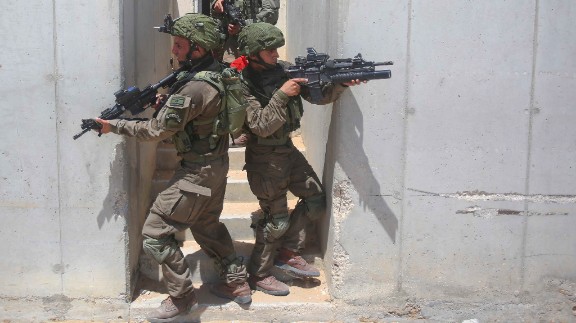
The inquiry’s finding is not limited to tolerance. It says Israeli authorities have enabled settler attacks through financial and military support, in a climate of impunity fostered by judicial and law-enforcement bodies. That support has a visible expression on the ground. Israeli security forces have routinely accompanied settlers and, the report says, acted as a shield for the violence. The line between enforcement and participation has thinned to the point where the report concludes increasing participation amounts to a de facto collapse of the distinction between settlers and soldiers.
Israel rejects that description. It rejects accusations that its troops shield settlers during attacks, describing such actions as rogue incidents that violate military protocol and are investigated. But Israeli and Palestinian rights groups say those investigations rarely lead to punishment. The claim of exception sits alongside a pattern that repeats.
Violence expands beyond attack into methodical intimidation and displacement
The pattern reaches beyond physical attacks. The commission documented cases of assaults, abductions and abuse of Palestinian children. In one case, a 12-year-old girl and her 3-year-old brother were abducted at knifepoint, tied to a tree until their family intervened. It also found settlers committed or threatened sexual violence to instil fear and harassed Palestinian women. These are not isolated acts; they are methods that produce displacement.
That displacement has a direction. The report says such violence has been used to advance state policy, including the unlawful occupation, displacement of Palestinians and the annexation of Palestinian territory. Hundreds of thousands of settlers now live among Palestinians on land Israel captured in a 1967 war, where Palestinians hope to build a state. Most countries and the U.N.’s top court consider the settlements a violation of international law, which Israel disputes. The legal argument continues; the physical reality expands.
External responses adjust while the underlying mechanics remain unchanged
External pressure has begun to adjust. On 11 May, the European Union approved sanctions on Israeli individuals and organizations involved in supporting settlement expansion. The move comes as violence intensifies, not before. In July 2024, the International Court of Justice issued a non-binding advisory opinion that Israel’s occupation should be withdrawn as soon as possible. Neither action alters the mechanics described in the inquiry.
Nor have internal measures. Despite periodic condemnations and the dismantling of some outposts, Israeli authorities have not taken sustained measures to stop the attacks. The absence is not procedural; it is continuous. Each day the structure holds, it produces the same outcome.
The inquiry also records abuses by Hamas in Gaza, noting it documented serious abuses by the group that controls the territory. But the finding does not redistribute responsibility in the West Bank. It places it.
The commission’s head called the “relentless, daily assaults… intolerable” and urged the international community to act. The language is urgent. The structure it describes is not.
A convergence of actors replaces any meaningful separation of roles
What the report identifies is not a failure of control but a convergence of actors. When security forces provide protection and authorities enable attacks within a system where investigations rarely lead to punishment, the distinction between enforcement and perpetration does not erode gradually. It disappears in practice. The consequence is already visible: a framework in which the state’s monopoly on force has not fractured but been redirected, and the people holding it are no longer operating on opposite sides of the line they are meant to enforce.