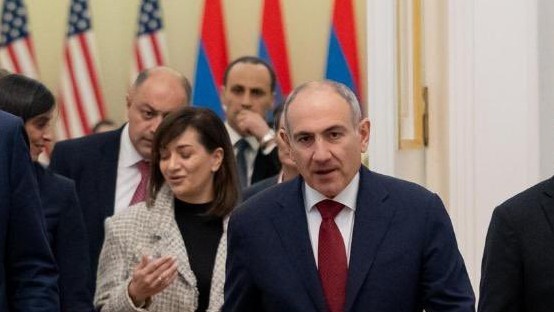
The numbers came in thin. Nikol Pashinyan’s Civil Contract party secured a slim majority, enough to govern, not enough to bend the state. Across the aisle, the Strong Armenia alliance won 25% of the seats, a bloc large enough to veto the future by refusing to rewrite the past.
That arithmetic does more than divide a parliament. It fixes the limits of what Pashinyan can deliver on the promise he made as ballots were still being counted: “The people of Armenia voted for peace, regional prosperity and regional cooperation”. The peace he is pursuing requires a constitutional amendment that he cannot pass. The gap between mandate and mechanism is now structural.
The election result defines not a direction but a boundary on what can be done
Brussels read the result as direction. Ursula von der Leyen hailed his victory as evidence of “a democratic Armenia” that was “drawing ever closer to Europe”, adding that “Armenia can count on us.” Washington has already moved from endorsement to brokerage; the US has taken an increasingly prominent role in efforts to broker a peace agreement between Armenia and Azerbaijan. Moscow saw something else: a government advancing westward without the votes to sever the ties that still bind it.
Those ties remain measurable. Total trade between Armenia and Russia fell to $6.7bn, a nearly 50% decrease, but Russia still accounted for 35.5% of Armenia’s overall foreign trade. Even after the collapse in volumes, Russia remained Armenia’s leading trading partner in 2025. The relationship has thinned, not broken. It still carries weight.
Economic ties shrink but continue to anchor the country’s strategic position
The drop has a cause that matters for what comes next. Analysts in Yerevan say Armenia has stopped being a key conduit for large-scale exports of Russian gold and diamonds to world markets. That shift removes a function that made Armenia economically useful to Russia at a moment of sanctions. It also removes a buffer that made the relationship resilient. What remains is dependence without the same degree of mutual convenience.
Moscow is adjusting accordingly. Its officials have begun to warn that Russian companies are becoming “wary of working with Armenia”. The Kremlin can tolerate rhetoric; it has signalled as much, expecting to preserve economic footholds while awaiting clearer signals from Yerevan’s domestic political cycle. It does not need to move quickly when the structure itself constrains Yerevan’s options.
Domestic limits on constitutional change reshape external leverage
That structure sits inside the state. Pashinyan built his case for peace on the argument that Armenia’s pursuit of Karabakh helped trap the country in perpetual conflict and dependence on Russia, and that ending it would unlock growth and security. The electorate accepted the premise; “Armenians are tired of war”, as one shopkeeper in Yerevan put it. But the mechanism for ending it runs through a constitution that still carries the language Azerbaijan rejects.
Baku has made the condition explicit. Any final agreement requires removing provisions that imply territorial claims to Nagorno-Karabakh. Pashinyan does not have the supermajority to call the referendum needed to change them. He failed to secure it. The peace he was elected to deliver depends on votes he did not win.
That constraint feeds directly into the balance of power outside Armenia. The imbalance increases exposure to pressure from external actors, including Azerbaijan and Turkey, both of which are already continuing persistent military pressure to extract further concessions even after securing control of Nagorno-Karabakh in 2023. A government that cannot amend its constitution cannot close the conflict on its own terms. Others will try to do it for it.
A divergence between political intent and economic reality becomes the governing condition
The economy does not offer a quick exit. Armenia is likely to maintain deep trade relations with Russia in the near term because of structural economic dependence, even as political distancing continues and economic disengagement remains gradual. The policy that emerges is already visible: a divergence between political pronouncements and economic implementation. Yerevan speaks west and trades east.
That divergence is not a transitional inconvenience. It is the condition under which every actor now operates. Europe offers political backing without replacing Russia’s share of trade. The United States brokers a peace that requires domestic changes Yerevan cannot enact. Moscow retains leverage without needing to escalate. Azerbaijan negotiates against a constitution that has not yet caught up with the battlefield.
The election did not resolve that tension. It fixed it in place. Pashinyan can deepen ties with the west while maintaining membership of the Russia-led Eurasian Economic Union, but he cannot align those tracks into a single direction without votes he does not control. The state he leads is now committed to a course it cannot fully execute.
That is where the pressure lands. A government elected to end a conflict cannot legally concede what its counterpart demands, while the economy that would cushion the adjustment remains tied to the power it is trying to leave. The constraint is not diplomatic. It is constitutional. And until those numbers in parliament change, Armenia’s foreign policy is being written by a document it cannot amend.