A truck is being loaded for Moscow, even as the men signing the export papers assume it probably won’t make it there.
Inside the Abovyan plant, women in white coats and hairnets work the conveyor with practised speed, pushing through bottles that have nowhere else to go. The destination has not changed. The certainty of arrival has.
Last month, Moscow announced a ban on imports from Abovyan, one of the country’s leading producers of Armenian cognac, officially citing sanitary concerns. Few in Yerevan treat it as a health issue. The ban sits inside a widening set of restrictions that now covers flowers, fish, fruit and its famed brandy, imposed by a trading partner that still absorbs roughly 40% of its exports.
Trade dependence collides with a political pivot that cannot be delayed
Samvel Goroyan does not dispute the exposure. “We just hope this all blows over,” he says, before adding, “All our cognac is sold in Russia, 7m bottles a year.” The number is not an estimate. It is the business.
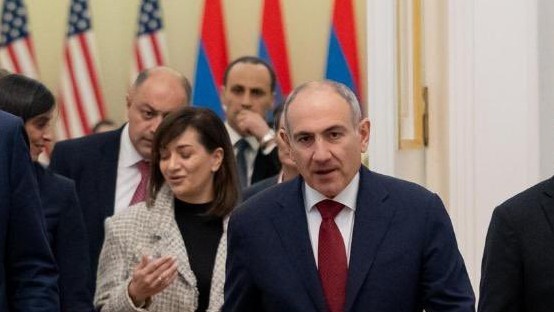
For three decades after 1991, Armenia was Moscow’s closest ally in the South Caucasus, a relationship that extended beyond trade to hosting Russian troops and buying Russian weapons. That structure has been coming apart under Nikol Pashinyan, whose government is pursuing the most significant foreign policy shift since independence by turning towards Europe. The vote on Sunday is a referendum on that direction, held against the reality of deep economic dependence on Russia.
Moscow has begun to price that shift as a loss. “Moscow feels it is losing Armenia,” said Thomas de Waal, adding that it is trying to force Pashinyan to make a choice – for Russia. The pressure is no longer implicit. Vladimir Putin warned Armenia could face a “Ukrainian scenario” if it continues its European integration, while Dmitry Medvedev hinted Pashinyan could suffer the fate of Leon Trotsky.
A security guarantee fails and exposes the limits of alliance
The threats followed a moment when the security guarantee underpinning the alliance failed in public. In 2023, Azerbaijan seized Nagorno-Karabakh, triggering an exodus of more than 100,000 ethnic Armenians. Russia, despite its role as security patron, stood aside as Azerbaijan seized control. The alliance did not collapse. It was shown to be optional.
Yerevan responded by testing that conclusion. Officials began questioning the value of the Collective Security Treaty Organisation, and Pashinyan suspended Armenia’s participation. The country then hosted a European Political Community summit attended by Volodymyr Zelenskyy and spoke openly about aspirations to join the EU. Each move widened the political gap with Moscow. None altered the underlying trade flows.
If anything, those flows intensified. After sanctions on Russia, Armenia’s exports to Russia tripled in 2022 and doubled again in early 2023. By 2023, trade with Russia accounted for over 35% of Armenia’s foreign trade, compared with the EU’s 13% share. Bilateral trade flourished even as political relations deteriorated.
Economic gravity tightens even as policy seeks escape velocity
The composition of that growth matters. The rise of new markets such as the United Arab Emirates reflects re-export rather than diversification. Russia remains the main export market, and its share has increased over time while the EU’s place has shrunk. The country’s trade balance—$8.4bn in exports against $13bn in imports—does not suggest spare capacity to absorb a sudden rerouting.
The government has started to subsidise its way out of that constraint. A programme offers 770 drams per kilogram of strawberries and 37 drams per flower to exporters willing to find alternative markets, targeting 4,250 tons of vegetables and 10 million flowers in a single month. The policy assumes those markets exist at scale. The trucks outside Abovyan suggest otherwise.
Meanwhile, Moscow has escalated from pressure to embargo. On the eve of the elections, it declared a “food war” on Yerevan, with restrictions spanning mineral water, vegetables, fruit, fish, wine and brandy. Russian agencies began gradually restricting shipments before expanding the list to seasonal fruits from cherries to grapes. Each category removed narrows the space for substitution.
A contradiction hardens into a test of political and economic limits
The result is a structure in which Armenia’s politics and its trade point in opposite directions. The country is diversifying its foreign policy, and deepening engagement with Western partners, even as economic and financial dependence on Russia remains significant. That contradiction is not new. What has changed is that Moscow is now actively enforcing it.
Georgia offers a precedent. Russian restrictions in 2006 dealt a painful blow but pushed producers to diversify. Yerevan intends to follow that path. The difference is timing. Georgia’s shift followed a rupture. Armenia is attempting it mid-dependence, while joining sanctions against Moscow would risk unprecedented economic downfall.
That leaves the country holding two incompatible positions at once: a political alignment it is trying to change, and a trade structure it cannot move fast enough to escape. The ban on Abovyan’s cognac is not an isolated sanction. It is a test of which side breaks first.
For now, the bottles keep moving down the line. But a business that sells 7m bottles a year entirely into Russia is not waiting for a market to recover. It is waiting for a political decision in Moscow that has already been made.