Iran’s crude exports fell from close to 2 million barrels per day to below 300,000 bpd in May, a collapse that arrived weeks after Tehran had used the same waterway to squeeze its rivals.
The sequence matters. When Iran closed the Strait of Hormuz, a channel that normally carries about 20 percent of the world’s oil and gas supplies, the immediate effect was to choke competitors. Global energy prices soared and shipments from Saudi Arabia, Kuwait, Iraq and the United Arab Emirates stalled. Iran, by contrast, kept moving cargo. Its exports remained strong through March and some of April, and higher oil prices boosted revenues. In March alone, exports averaged 1.84 million bpd, generating $165.6m a day.
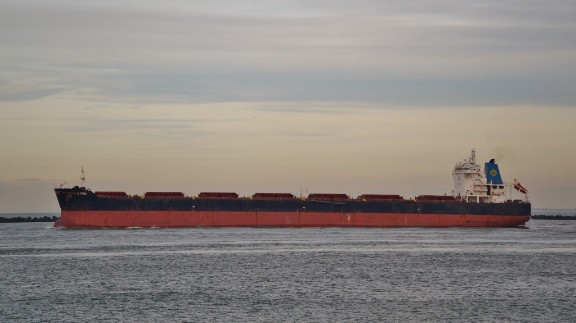
That advantage rested on a narrow asymmetry: Iran could disrupt the chokepoint without fully losing access to it. The asymmetry did not last. After the U.S. began enforcing a naval blockade on April 13, the amount of crude Iran could sell abroad dropped sharply, particularly to China, its largest customer. By May, revenues had fallen to roughly $27m a day, leaving oil income about 84 percent lower than in March.
The advantage that once sustained Iran’s exports reversed under enforcement at sea
The scale of the reversal becomes clearer when set against what Iran’s customers actually are. China buys more than 80 percent of Iran’s shipped oil. In normal years it takes around 1 to 1.5 million barrels per day, drawn by discounts of $5–$15 per barrel below benchmarks. Those discounts are not marginal. They save Beijing billions annually and anchor a supply strategy in which sanctioned producers absorb geopolitical risk in exchange for price.
That trade depends less on contracts than on movement. Oil exports account for about 80 percent of Iran’s total exports, and most of those barrels still need to pass the same geography Iran tried to weaponise. When the strait became contested space, global oil supply crashed by 10.1 million barrels a day in March, and hundreds of tankers were stranded in the Persian Gulf. The market shock that followed — a 65 percent rise in Brent prices by the end of March — priced scarcity, not durability.
Durability is now the problem. The blockade has not sealed every outlet. Some cargoes are being transferred between vessels near Malaysia, slipping past the most visible choke points. But the volumes that can move this way are marginal relative to what has been lost. Tehran is increasingly being forced to store crude it cannot sell, a condition that turns production into inventory and revenue into delay.
What looked like leverage now exposes the limits of Iran’s export system
Alternative routes exist on paper. Saudi Arabia and the UAE have pipelines that could bypass the Strait of Hormuz with 3.5 to 5.5 million bpd of capacity. But the logistics and supply chains needed to reroute substantial flows have not been robustly tested. For Iran, which lacks comparable redundancy, the constraint is immediate rather than theoretical.
The financial consequence is not abstract. If Tehran expected March-level income, it has already lost $5.8bn over April and May. Analysts say the blockade is beginning to inflict a high financial cost on the Iranian economy, raising questions about how long it can sustain the war. The pressure is cumulative: each day of restricted exports converts foregone barrels into fiscal stress.
What makes the position unstable is the dependency that remains intact. China’s demand did not disappear; its ability to receive did. Enforcement, not appetite, determines flow. Volumes have historically dropped to near zero under strict U.S. sanctions enforcement and rebounded when it loosens. The current regime is the strictest in years, and it is being applied at sea rather than on paper.
The chokepoint Iran weaponised now constrains its own economic lifeline
That leaves Tehran holding a paradox it created. The same chokepoint that briefly allowed Iran to profit from disruption now constrains almost all of its export capacity. Oil still accounts for the bulk of its external earnings, its largest buyer still sits on the other side of the route, and the passage between them is no longer functionally open.