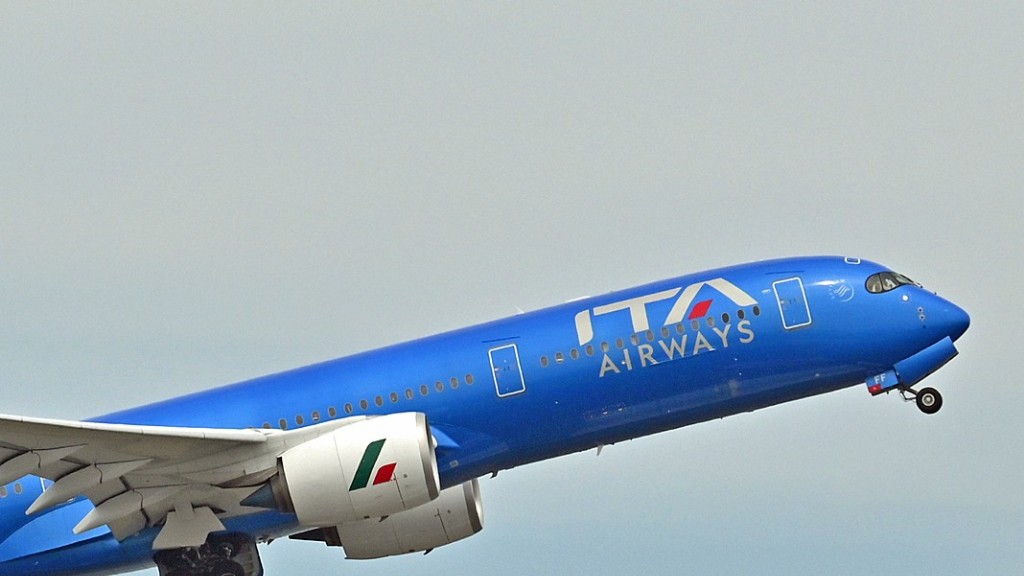
Almost a fifth of Italy’s flag carrier is sitting idle. Engine problems have grounded 20% of ITA Airways’ fleet of 80 aircraft, and the airline’s chief executive has put a clock on the response. “It’s imminent,” he said in Rio de Janeiro, adding: “We will have to decide within the next six to eight weeks.”
The decision he is describing is not operational. ITA Airways will decide within the next eight weeks whether to sue aerospace supplier RTX’s Pratt & Whitney. The grounding is already costing money the airline can count in real time: around €82,000 a day in lost revenue, accumulating toward €150 million over five years. The engines at issue — the PW1000 series geared turbofans — were sold on efficiency. They are now anchoring aircraft to the tarmac.
A defect understood becomes a bottleneck that the system cannot absorb
The defect is not a mystery. Pratt & Whitney discovered that certain engine components were manufactured from a faulty powder alloy, a flaw that can lead to microscopic contamination. Fixing it has required inspections and replacements at a pace the system cannot sustain. Long waiting times for engine inspections and repairs have become the constraint, and the manufacturing problem has put pressure on output of the GTF engines that were meant to define the next generation of narrowbody flight.
The scale extends beyond a single airline’s balance sheet. Hundreds of Airbus A320neo planes have been grounded globally, each one part of a fleet that has been rapidly re-engineered over the past decade. Airlines did not stumble into this configuration. They have been replacing legacy engines as part of a shift toward efficiency, sustainability, and fleet modernization. In 2019, those new engines were still a minority, accounting for only 13 to 15% of flights. The bet since then has been to make them dominant.
Efficiency gains replaced redundancy and concentrated the risk they were meant to reduce
That bet concentrated risk in a component that was supposed to reduce it. When a legacy engine failed, alternatives existed in scale. In 2019, the CFM56 alone powered over 300,000 flights, more than 55% of A320 activity, with another 30% coming from the V2500. The new architecture replaced that redundancy with performance gains tied to fewer, more complex systems. When those systems stall, the grounding propagates across fleets rather than isolating within them.
The financial consequences do not stop with airlines. The last time a core aircraft component failure cascaded through the system, it cut directly into national output. Economists estimated that the grounding and production suspension of Boeing 737 Max took between 0.24 and 0.4 percentage points per quarter out of US GDP. That programme had been Boeing’s fastest-selling aircraft, embedded in a company that remains the largest manufacturing exporter in the US with a supply chain of thousands of manufacturers. When it stopped, the effect was measurable far beyond aviation.
A regulatory system already under strain becomes part of the industrial constraint
The regulatory structure around that episode is still under scrutiny. A joint investigation by the U.S. Department of Justice and Department of Transportation Inspector General is continuing into the certification of the 737 Max. Investigators are not starting from a blank page. Federal Aviation Administration employees warned seven years ago that Boeing had too much sway over safety approvals, and auditors later confirmed the agency had not done enough to hold Boeing accountable. Inside the agency, employees described a “negative work environment” and retaliation for speaking up. The system that certified the aircraft was already under strain before the crashes that grounded it.
The present disruption sits on a different part of the aircraft, but inside the same industrial logic. Engine manufacturers supply critical components into a certification and maintenance regime that has already shown its limits under pressure. When a defect emerges, the bottleneck is not only technical capacity to fix it, but institutional capacity to absorb the failure without amplifying it. The waiting time for inspections is not an operational inconvenience. It is the system revealing how much slack it no longer has.
Legal action allocates cost but does not restore time to a system built without slack
For ITA Airways, the calculation is immediate: whether to turn a supplier failure into a legal claim. The airline is considering legal action to recover losses that it cannot offset through scheduling or pricing. But the lawsuit, if it comes, will not restore the aircraft to service any faster. It will only allocate the cost of a constraint that remains physically in place.
The more uncomfortable arithmetic sits with the manufacturers whose products define the new fleet. Pratt & Whitney’s geared turbofan was adopted because it promised structural savings — fuel burn, emissions, operating cost — across an industry that measures margins in percentage points. Those savings assumed continuous availability. The moment inspection delays and constrained output enter the equation, the economic model inverts: efficiency gains are overtaken by idle assets.
That inversion is already visible in the numbers airlines are disclosing. ITA Airways is facing significant financial losses due to the engine problem even before any legal recovery. Each grounded aircraft converts capital into a fixed cost without revenue. Each delayed repair extends that conversion. The supplier’s obligation is to fix the defect; the airline’s exposure is to time. Those are not the same variable.
The industry has, in effect, traded distributed inefficiency for concentrated precision — and discovered that precision fails in bulk. The A320neo fleet was reconfigured to run on fewer, better engines. When those engines falter, the consequence is not a marginal loss of performance but the removal of aircraft from service at scale. The system holds until it doesn’t, and then it holds nothing.
In Rio, the chief executive framed his decision as imminent. The grounding is already present tense. The legal action will name who pays for it. What it cannot change is the condition underneath: a global narrowbody fleet that has been redesigned around a component now moving more slowly through repair lines than aircraft can afford to wait, with the cost sitting today on airline balance sheets and nowhere else..
Cover photo Steven Byles CC BY-SA 2.0