Click to load the interactive map
The stern hung in the water while the bow refused to move. Satellite imagery from May 22 shows the stern swung out into the harbor as the bow remained on the side slipway, the result of a launch that had already gone wrong in public.
A day earlier, North Korea held a launching ceremony for what it called a newly built 5,000-tonne destroyer. Within hours, North Korean media reported on the failure of the launching, and the failure led to significant damage to the vessel. Pyongyang does not usually narrate its own technical breakdowns. This time it did.
The admission was paired with blame. Kim Jong Un was overseeing the ceremony when the vessel failed, and he condemned the accident as a “criminal act” that could not be tolerated. The language was political, not technical. It assigned fault before it explained cause, and it did so in a system where the supreme leader holds absolute power.
Blame arrives before explanation as political logic overrides technical sequence
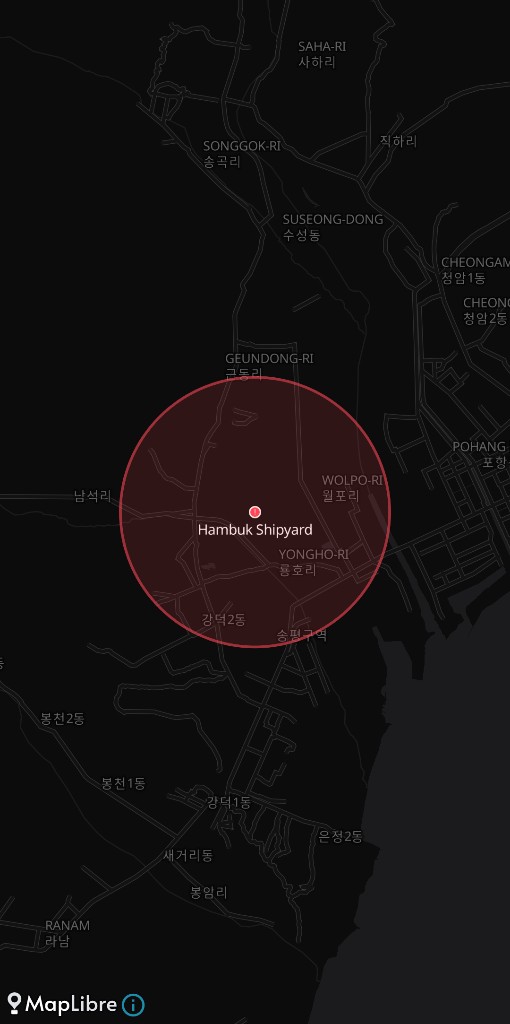
The cause, such as it is described, points to the yard itself. Analysts noted that it was unusual that the Hambuk Shipyard was selected to build the second ship of the class. The yard may have been another contributing issue. That choice sits awkwardly beside the scale of what Pyongyang is trying to build.
Because the vessel that failed is not the end point. It belongs to the Choe Hyon class, a 5,000 ton destroyer class that North Korea has already used to launch anti-ship and cruise missiles under Kim’s supervision. During those trials, two strategic cruise missiles were fired, and the term “strategic” in North Korean usage indicates nuclear warhead capability. The ships are not experimental in purpose. They are operational platforms for nuclear delivery.
Their design reinforces that role. Choe Hyon class destroyers integrate oversized missile launchers for ballistic missiles, and the vessels have demonstrated highly sophisticated capabilities that place them alongside systems fielded by the US, China, Japan and South Korea. That comparison matters because until recently, China was the only potential adversary navy procuring advanced destroyers at scale.
An industrial leap collides with the limits of a command economy
North Korea is now placing itself in that category while starting from a different industrial base. It remains a command economy whereby the state owns virtually all means of production, with food security an ongoing issue. Yet it is attempting to move from coastal defence to sustained operations at distance. Larger hulls make that possible: large ships can carry out much longer deployments with less reliance on resupply, and an 8,000 ton ship is expected to deploy significantly more firepower with expanded command facilities.
Pyongyang has not stopped there. An analyst told Reuters that this was the first time North Korea had mentioned a plan to build a 10,000-tonne destroyer. The failed launch, in that context, was not an isolated setback. It was a stress test of an industrial system being asked to scale faster than it has before.
The timing sharpens the pressure. A repaired vessel was relaunched within a month: the ship was repaired at Rajin port, and a second launching ceremony was held the following month, where the vessel was named Kang Kon. The speed of the turnaround suggests that the schedule mattered more than the lesson.
Diplomatic timing turns a technical failure into a strategic display problem
It also coincided with diplomacy. China has hosted 26 leaders from 23 countries this year, and its leader is due to visit Pyongyang for the first time in seven years as Pyongyang strengthens relations with Russia. One analyst said Kim might be looking to showcase his country’s capabilities before Xi’s visit. A capsized hull does not showcase capability. A relaunched one might.
The risk sits in the gap between those two images. North Korea is trying to field ships that could threaten US warships, supply ships, bases and aircraft across the region while its own launch infrastructure has just demonstrated it can fail in full view. The ambition is blue-water reach. The evidence, so far, is a yard where the stern can slide free while the bow stays fixed.
That mismatch is already carrying weight. A state that is a one-party totalitarian system has committed itself to a naval programme that depends on complex, sequential engineering under political deadlines. When the sequence breaks, the system does not slow down. It holds another ceremony.
The result is not uncertainty about what North Korea wants to build. It is clarity about what its shipyards are being asked to carry. The Hambuk yard has already shown what happens when that load shifts: the stern moves, the bow holds, and the structure in between takes the damage.